Published February 2, 2011
PM Lee pledges to keep housing affordable
Government to do more to stabilise the market should it become necessary
By JOYCE HOOI
(SINGAPORE) The government will do more to stabilise the property market should the occasion call for it, Prime Minister Lee Hsien Loong said in his Chinese New Year address this year.
'The government has acted to curb speculation and cool the property market. We will do more to stabilise the market if and when this becomes necessary,' he said yesterday.
'We will keep housing affordable to Singaporeans, especially public housing. At the same time, in a prospering economy, home owners should see their properties appreciating in value over the long term.'
The government had recently announced new rules that would raise the seller's stamp duty on properties to as much as 16 per cent of the sale price if the home is sold within a year, and lower the limit that banks can lend to home buyers for a second property to 60 per cent of the property's value.
On the immigration front, while the prime minister acknowledged the 'sense of dislocation and unfamiliarity' felt by some Singaporeans, he stressed the need to keep up with the world or face stagnation and decline.
'We need immigrants to reinforce our ranks, but we must maintain a clear majority of local-born Singaporeans who set the tone of our society, and uphold our core values and ethos.
'We are managing the inflow of foreigners who want to live and work here. Many want to become permanent residents and new citizens, but we will only select those who can add value to Singapore.'
He pointed out that last year, the nation's total fertility rate fell to an all-time low of 1.16. The Chinese fared worse than the national average, at 1.02, but the decrease in the fertility rate was observed across the board.
'It could have been because of the Year of the Tiger, or perhaps the economic uncertainties the year before, in 2009. Whatever the reasons, I hope more couples will start or add to their families in the Year of the Rabbit,' said the prime minister.
'Chinese New Year is the time for families to come together in celebration, and more babies can only mean more joy in the years to come.'
As part of the effort to ensure the longevity of values and culture, the nation's mother tongues needs to be kept alive, he said.
'We regularly update and improve the teaching of mother tongue languages in our schools, to keep it current and effective.
'Hence, the recent measures announced by the Ministry of Education, which will help a new generation to use their mother tongue languages freely in a changing language environment.'
Source: www.businesstimes.com.sg
PM Lee pledges to keep housing affordable
HDB resale prices up 2.5% in Q4 2010
Published January 29, 2011
HDB resale prices up 2.5% in Q4 2010
Up to 22,000 new flats may be offered under the build-to-order system
By UMA SHANKARI
HDB resale prices rose by 2.5 per cent in the fourth quarter of 2010 - a tad higher than the 2.4 per cent climb estimated earlier this month - even as the number of deals and the cash-over-valuation (COV) amounts commanded by flats fell.
Data from the Housing & Development Board (HDB) released yesterday showed that the official resale price index climbed to yet another new high in Q4 2010. For the whole of 2010, HDB resale prices rose by 14.1 per cent.
Prices rose even as the median COV amount among all resale transactions fell by $7,000 (or 23 per cent) from $30,000 in Q3 2010 to $23,000 in Q4 2010.
But prices still rose as valuations of most types of HDB flats climbed in Q4, analysts said.
The number of resale transactions fell by about 21 per cent, from 8,205 in Q3 2010 to 6,454 in Q4 2010. The total number of resale transactions in 2010 fell to 32,257, a decline of 13 per cent over 2009's volume.
Analysts said that HDB flat valuations still increased in Q4 2010, in spite of a number of cooling measures introduced in August 2010, as there is usually a lag time of about six to eight weeks before price corrections would align with the actual sentiment in the market.
But resale prices could soon plateau, PropNex chief executive Mohamed Ismail said.
HDB's Q4 2010 data shows that median resale prices of 3-room, 4-room, 5-room and executive flats stood at $300,000, $385,000, $460,000 and $548,000 respectively, he said.
But PropNex's in-house data for deals done in January shows median resale prices of $298,000, $393,000, $466,000 and $538,000 respectively - a 1.8 per cent drop to 2.1 per cent increase from Q4 2010.
'It must also be highlighted that some of our data reflects transactions that took place before the additional cooling measures announced on Jan 13, 2011,' added Mr Mohd Ismail. 'Feedback from the ground has indicated that there is less movement among the current HDB dwellers due to the (new) 60 per cent loan-to-value (LTV) cap. Therefore, it is possible to see a further dip, though not drastic one, for median COVs and sales volume in Q1 2011.'
HDB plans to offer up to 22,000 new flats under the build-to-order (BTO) system if demand is sustained.
The BTO supply will also be supplemented by the upcoming supply of flats under the design, build & sell scheme (DBSS) and the executive condominium (EC) housing scheme. Four more EC developments in Punggol, Pasir Ris, Bukit Panjang and Tampines will be launched for sale in the coming months by private developers.
Source: www.businesstimes.com.sg

DBSS site at Clementi launched for sale
By UMA SHANKARI
THE Housing and Development Board (HDB) has launched a site at Clementi Avenue 4 for sale under its design, build and sell scheme (DBSS).
An estimated 770 flats can be built on the plot, which has a site area of 235,800 square feet and a maximum allowable gross floor area of 825,300 sq ft. The site carries a lease term of 103 years (including a four-year construction period).
Analysts expect a top bid in the range of $200-$250 per square foot per plot ratio (psf ppr) for the plot. This translates to an overall land cost of $165 million to $206 million.
'This is one of the more attractive sites offered under the DBSS scheme,' said Nicholas Mak, head of research at SLP International. 'It is close to Clementi MRT station. Clementi New Town is also becoming more vibrant, with new projects such as The Clementi Mall.'
While buying sentiment has significantly moderated in both the public and private housing sectors, participation from developers for this site is likely to be motivated by the project's physical strengths and opportunities, said Ong Kah Seng, Cushman & Wakefield senior manager of Asia-Pacific research.
'This site is likely to see moderate interest from developers, who are still interested in providing homes for this specific segment although generally, home-buying sentiments are expected to remain cautious in the months ahead,' Mr Ong said.
The last site offered for sale under the DBSS scheme, at Yuan Ching Road in Jurong, drew a top bid of $192 psf ppr. Six bids were submitted for the site.
The tender for this site will close at noon on March 8, 2011.
Last year, HDB sold five land parcels for DBSS development in Yishun, Bedok, Tampines, Hougang and Jurong West. These five land parcels will yield about 3,000 DBSS flats, and this pipeline supply will come on-stream progressively in 2011.
Another DBSS site at Pasir Ris Central, with an estimated yield of 460 units, will be launched for tender in March. More sites for DBSS development will be made available if there is sustained demand, HDB added.
Flats sold under DBSS are offered to buyers under HDB's eligibility conditions. But the developers who buy such sites have some flexibility in designing, pricing and selling the flats.
Source; www.businesstimes.com.sg
Booklet of Mah Bow Tan's thoughts on housing
Booklet of Mah Bow Tan's thoughts on housing
By UMA SHANKARI
THE Ministry of National Development (MND) is publishing a booklet containing the musings of its minister, Mah Bow Tan, in a bid to reach out to more Singaporeans and explain housing policies.
In response to a query from BT, Mr Mah said that the booklet will contain nine commentaries that encapsulate his thoughts on Singapore's public housing programme over the past five decades.
This should give readers an insight into the thinking behind the policies that shape the system Singapore has today.
Said Mr Mah: 'Today, eight in 10 Singaporeans stay in HDB flats, and nine in 10 of them own the flats they live in. This is the highest home-ownership rate in the world. No other country comes close.
'But, public housing is not just about putting roofs over people's heads. It is also about building inclusive homes and communities.
'This has not been an easy effort. There is a finite budget to work with, and policy trade-offs to be made.
'With this booklet, I hope to reach out to more Singaporeans, to tell them about our ongoing housing story, and to enhance their understanding of the policy considerations behind this success story,' he added.
The booklet will be released in either February or March this year.
MND plans to distribute the booklets to relevant entities such as HDB branch offices, town councils, public libraries, and academic institutions.
In addition, the booklet could be sold in selected bookstores.
It might also be available in a Mandarin version, sources said.
Source: www.businesstimes.com.sg
DBSS site at Clementi launched for sale
Published January 26, 2011
DBSS site at Clementi launched for sale
By UMA SHANKARI
THE Housing and Development Board (HDB) has launched a site at Clementi Avenue 4 for sale under its design, build and sell scheme (DBSS).
An estimated 770 flats can be built on the plot, which has a site area of 235,800 square feet and a maximum allowable gross floor area of 825,300 sq ft. The site carries a lease term of 103 years (including a four-year construction period).
Analysts expect a top bid in the range of $200-$250 per square foot per plot ratio (psf ppr) for the plot. This translates to an overall land cost of $165 million to $206 million.
'This is one of the more attractive sites offered under the DBSS scheme,' said Nicholas Mak, head of research at SLP International. 'It is close to Clementi MRT station. Clementi New Town is also becoming more vibrant, with new projects such as The Clementi Mall.'
While buying sentiment has significantly moderated in both the public and private housing sectors, participation from developers for this site is likely to be motivated by the project's physical strengths and opportunities, said Ong Kah Seng, Cushman & Wakefield senior manager of Asia-Pacific research.
'This site is likely to see moderate interest from developers, who are still interested in providing homes for this specific segment although generally, home-buying sentiments are expected to remain cautious in the months ahead,' Mr Ong said.
The last site offered for sale under the DBSS scheme, at Yuan Ching Road in Jurong, drew a top bid of $192 psf ppr. Six bids were submitted for the site.
The tender for this site will close at noon on March 8, 2011.
Last year, HDB sold five land parcels for DBSS development in Yishun, Bedok, Tampines, Hougang and Jurong West. These five land parcels will yield about 3,000 DBSS flats, and this pipeline supply will come on-stream progressively in 2011.
Another DBSS site at Pasir Ris Central, with an estimated yield of 460 units, will be launched for tender in March. More sites for DBSS development will be made available if there is sustained demand, HDB added.
Flats sold under DBSS are offered to buyers under HDB's eligibility conditions. But the developers who buy such sites have some flexibility in designing, pricing and selling the flats.
Source: www.businesstimes.com.sg
HDB launches 3 BTO projects with 1,728 flats
Published January 26, 2011
HDB launches 3 BTO projects with 1,728 flats
Bt Batok project will have 180; projects in Yishun will have total of 1,548 units
By UMA SHANKARI
THE Housing & Development Board (HDB) yesterday launched for sale three more build-to-order (BTO) projects - one at Bukit Batok and two at Yishun - with a total of 1,728 standard flats.
The Bukit Batok project, Golden Daisy, will comprise solely of 180 studio apartments which will sell for between $83,000 and $118,000 each.
The two projects in Yishun - Orchid Spring @ Yishun and Vista Spring @ Yishun - offer a mix of two-room, three-room, four-room and five-room flats. Orchid Spring @ Yishun, located along Yishun Avenue 11, will have 948 units while the adjacent Vista Spring @ Yishun offers 600 flats.
Prices at the two projects range from $93,000 to $112,000 for a two-room flat; $150,000 to $183,000 for a three-room flat; $230,000 to $278,000 for a four-room flat; and $292,000 to $353,000 for a five-room flat.
Analysts said the attractive pricing of the Yishun flats would be a draw and expect that over-subscription rates for the projects could be as high as five times. The two projects are located in the same vicinity as a sold-out private condominium project, The Estuary.
'Pricing is attractive when compared to resale flats in the same locality that are about 22-24 years old. The new three-room flats are 30-40 per cent cheaper, while the four-room and five-room flats are 7-12 per cent and 16-21 per cent cheaper respectively,' said ERA's key executive officer Eugene Lim.
The flats at Yishun are clearly targeted at young couples and families, analysts said. Besides playgrounds, fitness stations and a jogging track, Orchid Spring even boasts a child care centre within the development itself.
By contrast, the 180 units at Golden Daisy are meant for senior citizens, observed PropNex corporate communications manager Adam Tan. But the apartments are not likely to be keenly contested for as studio apartments are never in very high demand, Mr Tan added.
HDB has ramped up its new flat supply significantly to meet the demand from first-timer households.
This year, the agency will offer up to 22,000 new flats under its BTO scheme if demand is sustained. This is 24 per cent more than the 17,700 flats offered for sale under the BTO scheme and sale of balance flats exercise in 2010.
In the first six months of 2011, about 11,000 new BTO flats will be offered. The upcoming projects will have a good geographical spread in towns such as Bukit Panjang, Jurong West, Punggol, Sengkang and Yishun, HDB said.
Source: www.businesstimes.com.sg
Pay more attention to raising supply
While the Government has to act to prevent the property market from getting beyond the reach of most Singaporeans, I am however not very comfortable that the latest steps - announced last week - are the best means of dealing with the issue.
Not only are the measures fairly drastic, they appear to be dealing more with curbing demand than raising supply.
The Government has claimed that there is no shortage of supply. It points out that the sites awarded last year under the Government Land Sales Programme (GLS) will yield about 13,300 units. For the first half of this year, it says it will make available sites that would be able to yield about 14,300 units.
Further, as at the end of the third quarter of last year, there were about 64,400 uncompleted units in the pipeline, of which roughly half were still unsold. These compare with the annual take-up rate of about 12,700 units between 2007 and last year. Unfortunately, there is a lag period between the site award and the sale of the property.
The latest attempt to cool the property market may have the unintended effect of reducing supply as developers decide to take a wait-and-see approach. They might be even willing to pay the penalties for missing completion deadlines rather than sell at a loss. It could also see the bigger developers with the financial muscle to hold being able to take advantage of those who can't hang on to their sites.
And will the new rules which took effect the day after they were announced - Jan 13 - force buyers to give up options, now that financing will be more difficult to obtain?
Under the new rules, financial institutions can only grant loans amounting to half the value of the properties purchased by non-individuals, such as companies, trusts and collective investment schemes. Individuals with existing outstanding mortgages can now borrow only up to 60 per cent of the value of their next property purchase.
Another unintended effect could be that those who have the financial resources will be able to get more properties on the cheap - to sell when prices recover later.
But should the Government be overly concerned with private-sector housing? Should it be going all out to prevent a fool from parting with his money?
Despite numerous warnings about the dangers of a property bubble bursting and that the current low interest rate regime might not last for too long, property prices, prior to the latest measures, continued to climb.
I believe the Government should be more concerned about housing the masses. It has done a marvellous job, having built more than one million units since the Housing and Development Board (HDB) was established. At present, some 900,000 units house more than four-fifths of the population. For the vast majority of newly-weds, their first home is likely to be an HDB flat. These are the people whom the Government has to be concerned with.
The Government has said it will be building more HDB flats - up to 22,000 Build-To-Order flats this year - to accommodate the masses. Will these be enough?
It should perhaps also get out of building executive condominiums (EC) units which provide condo-like facilities and the Design, Build and Sell Scheme (DBSS) units. The HDB says land for some 8,000 of these could be launched this year. Why should the HDB be catering to the needs of this select group?
Look at what is happening to the estates that were built by the HUDC for an earlier group of the so-called sandwiched class. Some like Farrer Court, Amberville and Bedok Reservoir, have been sold en bloc to private developers. The remaining ones - Shunfu, Braddell Heights, Pine Grove, Laguna Park, Neptune Court, Chancery Court and Eunosville - have been privatised or are in the process of being privatised in anticipation of en bloc sales. Why must public funds be used to cater to such profiteering?
Rather than be all things to all people, the Government should concentrate on housing the masses.
by Conrad Raj
05:55 AM Jan 21, 2011
Conrad Raj is editor-at-large with Today.
Source: www.todayonline.com
Three GLS sites launched for sale
SINGAPORE - The Housing and Development Board is launching today the tender for three 99-year leasehold residential sites under the Government Land Sales Programme for the first half of this year.
The first site, at Bishan Street 14, has an area of almost 12,000 sq m and can potentially yield 650 dwelling units. The site is located near Bishan MRT Station and Junction 8 Shopping Mall, Raffles Institution and Catholic High School.
The land parcel under the Reserve List has been put up for tender after a developer committed to bid at least $189.8 million. The tender will close on Feb 24.
The second site, located along Sengkang Square and Compassvale Road, has an area of 17,700 sq m and can potentially yield 530 dwelling units. The site is located near Compass Point shopping mall, Sengkang Community Club and the Tampines Expressway. The tender will close on March 15.
The third land parcel is located at Choa Chu Kang Drive and has an area of 17,589.8 sq m with a potential yield of 490 dwelling units. The site is located near Lot 1 shopping mall, Yew Tee Square and Choa Chu Kang Stadium. This tender will close on March 22.
05:55 AM Jan 21, 2011
Source: www.todayonline.com
Lay down the cooling measures to be taken upfront
by Colin Tan
Updated 11:11 AM Jan 14, 2011
In a Sunday feature article entitled "History-making year ahead", eight events and issues were highlighted by the writer which are expected to loom large in 2011. Seventh on the list was how to cool the property market without crashing it.
Last year, private housing prices eclipsed the previous 1996 peak, while the cash-over-valuation (COV) levels for public flats reached historic highs even as the Government unveiled two sets of cooling measures and ramped up the supply of housing sites and the number of new public flats for sale. It was a tumultuous year to say the least.
While the events in the property market may not be as central as the General Election and Presidential Polls listed as first and second on the list, it has the potential to significantly affect the results of the two.
Fortunately, the impact of the most recent set of cooling measures appears to have yielded results for the time being at least.
Flash estimates released by the Urban Redevelopment Authority (URA) recently show that private housing prices edged up by only 2.7 per cent in Q4, down from 2.9 per cent in Q3, albeit taking the price index to a fresh high.
However, sales volumes have not dampened. Over 15,500 new private homes are estimated to have been sold last year - a new benchmark.
Over at the HDB market, prices of resale flats rose 2.4 per cent in Q4 2010 - a slower rate of growth than the 4 per cent increase in Q3 2010. But while the resale price index was pushed to yet another all-time record, transaction volumes fell.
The resale volume declined by about 21 per cent in Q4. The median COV amount is also estimated to have fallen by $7,000 or 23 per cent, from $30,000 in Q3 to $23,000 in Q4 2010. But prices of public housing resale flats are still going up.
With the region awash with liquidity and healthy economic growth, the upward trend of the property market is expected to continue in 2011.
The finalised set of market numbers will determine whether a new round of cooling measures is forthcoming.
However, even if prices remain stable, if sales of new homes continue to be very high, then the concern is that a lot of it may not be owner-occupier demand. This has strong ramifications for the rental market. If the cost of borrowings should suddenly shoot up, a crash cannot be ruled out even if our track record shows that we have always managed a soft landing.
To outsiders who are not familiar with our housing market, all of our current market indicators, including those on the economic front, are gelling together to produce what can be considered to be the perfect property bull run if there is such a thing.
It is a sign of the anxious times, when single-property owners have mixed feelings even as many are made millionaires on paper.
Personally, I am not so sure the effects of the latest set of cooling measures will last. Our housing market must be among the most open and attractive to investors all over the world.
Is it time for some measures regulating the amount of liquidity flowing into Singapore and into the local housing market? Can there be more focused cooling measures without affecting genuine buyers and sellers? Is it time to pool together all the data of all the various government bodies to get to the bottom of the "problem" if it has not already been done yet?
It is very difficult to suggest solutions if there are still big gaps on what we know about the market. If the gap persists should not there be greater efforts to plug them?
Much as I like speculators to learn from their mistakes, a crash benefits no one.
Personally, I am not in favour of changing the goal posts midway with respect to investors. It breeds uncertainty and affects investor confidence. As I see it, part of the problem is that the market does not appear to take the Government's warning - that it will not let the market overheat - seriously. Either that or it has short memories.
I prefer a more direct approach. Lay down all the cooling measures to be taken upfront. Have four sets, one for each quarter. Set the trigger points for each of them, say x per cent rise in the price index. If the price index surpasses this figure, the first set of cooling measures automatically kicks in and so on. The trigger points can be linked to fundamentals, say the percentage GDP growth for the previous quarter plus x per cent.
This should send a very clear message to investors. At the same time, the market has a choice; whether it wants to trigger the measures or not.
Colin Tan is head, research and Consultancy, at Chesterton Suntec International.
Source: www.todayonline.com
Affordable hotspots
Experts say mass-market condos will lead housing demand this year
by Joanne Chan
05:55 AM Jan 07, 2011
SINGAPORE - With private home prices at record highs, industry players expect developments catering to the mass market to lead demand this year.
Property is seen as a safe and appreciating asset, they say, adding that Singapore's growing economy and low borrowing rates have injected ample liquidity into the market. But even as property is viewed as a good investment, affordability will be key as prices continue to trend higher, they add.
With the Housing and Development Board resale market largely closed off to private property owners, those looking for a second property to invest in are now eyeing mass-market condominiums.
Mr Chris Koh, director of Dennis Wee Group, said: "They already have one private property. The funds that they have are very limited to invest in another high-end private property. They had thought of a HDB flat a year ago, but now they've decided to buy another mass-market, lower-end private property."
Cooling property measures introduced on Aug 30 last year disallow dual ownership of private property and an HDB flat. A private home owner has to sell off his property before he's allowed to buy an HDB flat.
Foreigners settling here will also drive demand for mass-market condos - typically those going for $1,000 psf or less.
Mr Koh added: "We have two groups of foreigners. We have foreigners who are very rich, and there are foreigners who come to Singapore who just want a new place for their children to grow up. They are not as rich as the high-end. So a lot of them enter the mass market. They will buy condominiums near public schools. They will buy condominiums near public transportation."
Foreign investors who traditionally might have snapped up more expensive developments are also thinking twice.
Mr Colin Tan, Chesterton Suntec International's head, research and consultancy, said: "People see risk. So even though they may have enough cash to put a downpayment for something high-end or in the mid-tier, I think sometimes, in order to mitigate the risk, they may still go for the mass market."
Despite a third round of property cooling measures last August, Singapore is still widely seen by investors as a good place to park their money, especially when compared to other countries in the region which have introduced tougher anti-speculation measures.
Hong Kong, for example, imposed a 15-per-cent-stamp duty on all properties sold within six months of purchase.
Market watchers expect private home prices to inch up 1 to 2 per cent each quarter this year, in line with Singapore's expected economic growth.
Source: www.todayonline.com
Revisiting housing supply
Based on URA and HDB projections, there could be a deluge of homes in 2013 and 2014
by Ku Swee Yong
05:55 AM Jan 07, 2011
It was a week before last Christmas when we celebrated the Housing and Development Board's (HDB) completion of 1 million flats.
This is an awesome achievement. With 1 million flats averaging about 1,000 sq ft each, the HDB has within 50 years completed and handed over a billion sq ft of residential space. A billion sq ft. One, followed by nine zeros. That is more square footage than the above-ground portion of the Great Wall of China, which spans 6,500km.
Now, the actual number of HDB flats that exist today is just below 900,000. According to the HDB's annual report, as of March 31, 2010, there were 890,212 flats under management. More than 100,000 flats have been demolished since the '70s, many of them rental flats. Older estates, such as Brickworks and Queenstown, have been upgraded.
Over the years, small individual estates have also been amalgamated into towns such as Bukit Merah Town, Clementi New Town, etc, under various estates renewal programmes, such as Selective En bloc Redevelopment Scheme (Sers).
The completion of an average of 20,000 flats per year in the HDB's 50-year history was in tandem with the growth of Singapore's population.
In the last 15 years, from 1995 to 2010, population growth (Singaporean citizens and permanent residents) averaged 50,000 per year, accommodated by the growth of public (additional 13,950 flats a year) and private housing (8,593 units a year). This is an average of one apartment for every two to three Singapore citizens and PRs. If we included non-residents (Work Permit and Employment Pass holders, for example), then this is an average of one new HDB or private home for every four new people added to the "headcount" in Singapore.
Table 1 shows the actual supply of physical units versus population growth. The 15-year data looks balanced.
However, within the 15 years, there were several tumultuous periods. Early on, a long queue of up to five years for HDB flats formed due to a perception of supply shortage and rising prices. Executive Condominiums were introduced.
The massive construction boom around 1995, with fuel added by en-bloc deals, led to a massive increase of 44,000 residential units per year in the period spanning 1998 to 2000. This is net additional physical supply; that is, demolitions from en-bloc deals have reduced the total count.
THE SCOURGE OF SARS
The economy dipped in 2001 after the dotcom crash, which was followed by 911, Gulf War II, the Bali bomb blast, and then Sars. The blip during the Sars crisis was the worst: A recession with a population exodus of 61,000 in 2003, during which there was an accumulated excess of residential units.
By March 2004, HDB announced it would stop building five-room flats because it had 10,000 units that were waiting to be taken up. At that time, three-bedroom private apartments could easily be had at $500,000 and there was little demand from a population that shrank by 61,000.
The over-supply, apparent since 2001, brought on a revamp of the HDB and the introduction of the Build-To-Order (BTO) scheme. HDB flats will be constructed only when there are enough buyers, allowing the board to adjust supply based on demand from applicants.
In 2002, the registration for flats system was suspended and till today, the BTO scheme remains the main mode of HDB's sales. The Design, Build and Sell Scheme (DBSS) was introduced in 2005 for private sector developers to participate in public housing projects. This scheme contributes about 10 per cent of total new HDB supply.
The period of 2004 to 2005 was one of slow growth as there was excess supply which had to be absorbed by new demand from the population growth before equilibrium could be reached. Government Land Sales slowed down, leading to the next squeeze.
MARKET RECOVERS AMID EN-BLOC FEVER
From 2006 to 2008, real estate prices recovered on a combination of factors, including: (a) rapid population growth on the back of strong jobs creation; (b) rosy economic outlook spurred by the promise of the integrated resorts; (c) developers replenishing freehold land bank through en bloc transactions and (d) small number of project starts in 2003 to 2005 leading to low completion numbers in 2006 to 2008.
Of the above factors, the en bloc phenomenon created the biggest squeeze because it (a) demolished physical housing units to make way for redevelopment, reducing total stock; (b) put millions of dollars of windfall into the hands of the en bloc sellers, amplifying purchasing power, and (c) en bloc sellers had to buy another property for their own stay at a time when net new supply was already low.
The average growth of population in the last five years - from 2006 to last year - was 162,000 per year. The demand for housing was way higher than the net supply growth of private residential at 5,780 units per year and the additional supply of 2,129 HDB flats per year, partly due to Sers rejuvenation of older estates. The timing could not have been better.
If we narrowed our analysis down to the numbers for 2006 to 2008, the shortage of space is even more pronounced. Vacancies dropped to a low of around 4 per cent as the average annual increase of 4,077 units of private residential stock (TOP completions minus en bloc demolitions) and 1,858 units of HDB stock were hardly enough for the influx of population at 191,200 a year! Assuming the new population agreed to squeeze into residential units 10 people at a time, we would need a supply of 19,100 units each year in 2006 to 2008. But the additional stock count was only 5,935. So naturally, rentals and capital values spiked.
SUPPLY OUTLOOK
We need to look at the planning for physical supply and not merely the real estate market based on launches and pre-sales. Some schools of thought favour the idea that, in land-scarce Singapore, property investors merely care about capital gains, not the steady rental income stream. For me, I stress the importance of long-term returns from real estate and therefore, I keep a close eye on physical supply and asset utilisation.
A property has real value only when it is well-used. Most hard, capital-intensive assets are like that: Ships, aeroplanes, machinery, satellites, ports, highways, and so on. If you leaned towards feng shui, you would also believe that the higher the human traffic and goods flow (especially for industrial, retail and commercial properties), the better the property.
An over-supply of completed residential properties, with insufficient end-users and poor utilisation, would naturally lead to price weakness.
Conversely, insufficient supply or too-rapid a population or demand growth will lead to sky-rocketing prices - similar to the situation in 2007. This would not go down well with our central planners. Despite being a top-notch economy, Singapore does not like to price itself out of the market. So, we can expect more supply to quench the fire of rising prices.
Since the middle of 2009, public housing demand has been robust and prices have moved up sharply. From Table 2, we see that HDB launches of BTOs were ramped up significantly last year.
According to the HDB: "The ramp-up of flat supply is part of a series of additional measures to reinforce the Government's commitment to provide affordable and adequate public housing supply for first-timer households." If demand remains strong, the HDB may launch up to 22,000 BTO flats and release land for 7,000 DBSS units this year. That's a potential 29,000 HDB units. That's huge.
However, the numbers do not indicate when the physical supply will be completed. The HDB supplies new flats based on various demand factors, such as new households formed from marriages, number of resale transactions, etc. To satisfy the strong demand and in order to shorten the waiting time for first-time buyers, Mr Mah Bow Tan, the Minister for National Development, has announced that the HDB will endeavour to complete construction within two-and-a-half years, shorter than the previous average of three years, for all BTOs starting from September last year.
Based on the above information, public housing supply is estimated to be as shown in Table 3:
If we net out the number of HDB units that may be demolished for estate renewal, the supply looks comfortable, especially since most of the BTO flats have found owners before construction began.
However, if we look at the total supply of residential units (both HDB and private) as shown in Table 4, the numbers become somewhat scary.
If you recall from Table 1 above, the 15-year average annual supply is about 22,000 units of HDB and private housing. The recent record high Government Land Sales programme and the ramp up of HDB supply may lead to a supply of over 30,000 units in 2013 and 43,000 units in 2014.
The last time so many residential units were completed was during the period of 1998 to 2000, when an average 44,000 units were completed per year. That was a supply level that was challenging to absorb as new family formations through marriages tracked at around 25,000 per year and thepopulation increased at 70,000 per year. And not all newly-weds purchase homes or move out of their parents' nests, while new population may come in the form of students or contract workers who occupy dormitories rather than residential units.
That period of over-supply led to a long period of indigestion from 2002 to 2005, when prices stagnated on the back of an economy hit by Sars and external turbulence. Vacancies of private residential units hovered above 8 per cent for most of 2002 to 2005, much higher than the 5 to 6 per cent of 2009-2010.
WHAT MIGHT BE THE LEVERS TO PULL?
Should the Urban Redevelopment Authority's projections of residential completions be accurate and HDB supply remains high, we must brace ourselves for a deluge in 2013 and 2014. We are now in 2011, so that gives us over a year to prepare. There are, however, a few ways that may mitigate the over-supply threat:
- Speeding up estate renewal programmes
By 2015, there will be more than 200,000 flats that will be over 30 years old. Old flats could be torn down sooner. Current tenants will be given notice to move out into other HDB flats. However, HDB's pace of renewal programmes is not entirely clear to market watchers, so I would not be able to take a stab here.
- Slowing down construction
The HDB can choose to slow down the supply of new flats. In the case of BTOs, the process of applications, queueing, balloting, selection, etc, and then contracting the construction companies to build are within the control of HDB. If physical supply is high and vacancies increase, the completion of construction could be delayed for the market to take up some slack.
- Embracing more foreigners
The demand side of the equation could be jacked up by welcoming more foreigners to our shores. This is especially so if the economic growth in the next five years can hold up at 5 per cent or higher, ensuring that jobs growth will be robust. If executed well, an increase in housing demand produces the best outcome for the whole market.
It remains to be seen if the large supply can be supported by demand. It is critical for stakeholders to make informed decisions, thinking through a comprehensive set of real estate data such as housing demolitions, population growth policies, public and private housing TOPs, etc, to the extent that such information is available.
The writer is the founder of real estate agency International Property Advisor (IPA), which provides services to high-net-worth individuals.
Soure: www.todayonline.com


Bishan residential site up for tender
Published January 8, 2011
Bishan residential site up for tender
By EMILYN YAP
THE Housing & Development Board will be launching a 99-year leasehold residential site at Bishan Street 14 for tender in about two weeks' time.
Consultants expect to see as many as eight bidders for the plot, which is located near Bishan MRT station.
The 1.2 ha site on the reserve list, with a maximum gross floor area of 632,764 square feet, can yield an estimated 590 condominium units.
An unnamed developer triggered the sale when it committed to pay at least $189.8 million or $300 per square foot per plot ratio (psf ppr).
The plot is within walking distance of Bishan MRT station and Junction 8 shopping mall. It is also near several education institutions - ITE College Central (Bishan) is next door while Raffles Institution is a few streets away. A few other parcels of state land surround the site.
Cushman & Wakefield senior manager of Asia-Pacific research Ong Kah Seng believes that the top bid might come in at $450-480 psf ppr, which could translate to selling prices of $920-950 psf.
According to caveats lodged with the authorities, units at Bishan 8 nearby went for $852-955 between August and October last year.
There is likely to be moderate demand from developers because of the site's location, Mr Ong said. The winning developer will get a headstart in offering condominiums in that area, and could potentially acquire the surrounding plots when the government includes them in the land sales programme, he added.
SLP International Property Consultants' research executive director Nicholas Mak expects some of the higher bids to reach $460-530 psf ppr.
Although many residential sites on the confirmed list will be rolled out for sale in the first half of this year, this plot at Bishan remains attractive because of its location, he said.
Besides, mass-market homes should continue to enjoy demand even if price growth may be limited this year, he added.
Source: www.businesstimes.com.sg
Jurong public housing site attracts top bid of $131.6m
Published January 6, 2011
Jurong public housing site attracts top bid of $131.6m
By FELDA CHAY
A TIE-UP between Hoi Hup Realty, Sunway Developments and SC Wong Holdings has put in the highest bid of $131.6 million for a public housing site on Yuan Ching Road in Jurong.
This is 5 per cent above the second highest tender from Yuan Ching Development. Six bids were put up for the site, which can potentially yield 580 flats. The lowest bid was $68.5 million.
The top bid translates to a per square foot per plot ratio (psf ppr) price of $192 for the site under the Design, Build and Sell Scheme (DBSS), which is 'within expectations', said Ong Kah Seng, senior manager of Asia-Pacific research at Cushman & Wakefield.
This is, however, 'considerably lower than that of recent DBSS sites awarded, which are at least $200 psf', said Mr Ong. This could be due to the less central location of the plot of land, as compared with previous DBSS sites located in Upper Serangoon and the Bedok Reservoir area.
Overall moderation in home- buying sentiment in the public residential sector could also have played a part, Mr Ong added.
Credo Real Estate executive director Ong Teck Hui said the six bids put up for the site showed there was 'fair interest' in the tender. 'Going forward, bidders would be mindful of the supply of DBSS sites coming into the market. Response in terms of bid prices and participation level will depend on the locations and attributes of the sites,' he said.
The 2.1 hectare Yuan Ching plot is near Jurong Lake and the Jurong Country Club golf course, as well as education institutions such as Jurong Secondary School. Both Lakeside and Boon Lay MRT stations are several bus stops away.
The land parcel has a maximum allowable gross floor area of 684,574 sq ft and carries a lease term of 103 years (including a four-year construction period).
The Housing and Development Board (HDB) said it will evaluate the tender bids and announce the final results within the next two weeks
Source: www.businesstimes.com.sg
As private residential property prices rose 17.6 per cent
SINGAPORE - Prices of private residential properties hit new highs in the fourth quarter of last year, capping a year of spectacular surge in private home prices.
According to flash estimates from the Urban Redevelopment Authority (URA) yesterday, the price index for private residential property jumped 17.6 per cent last year - a 10-fold spike in the rate of increase compared to the recession-hit 2009, when overall prices of private properties rose by 1.7 per cent.
The spot of good news for private home hunters is that the increase in prices appears to be moderating: Prices rose 2.7 per cent between October and December, compared to a 2.9 per cent increase in the third quarter.
With private home prices already surging past their 1996 peaks, property analysts believe there is little room for further increase; and as prices stabilise, they noted that the Government may not need to introduce new measures to curb overheating any time soon.
Cushman & Wakefield vice- chairman of property brokerage Donald Han said: "If you look into the price increases we saw both for HDB and private property, the price increases were in the comfortable range, between 2 per cent and 3 per cent quarterly ... Alarm bells will ring if you see a quarter-to-quarter increase of between 5 and 6 per cent, or even in excess of that."
For the whole of 2010, private home prices surged 14.3 per cent, 17.5 per cent and 14.5 per cent in the central, city-fringe and suburban regions, respectively.
Property analysts said increases of similar magnitude are unlikely to be seen this year as economic growth moderates.
Singapore's economy is expected to expand between 4 and 6 per cent this year, compared to an estimated 14.7 per cent growth last year.
Prices of non-landed residential properties in the core-central region increased 2.3 per cent in the fourth quarter, more than any other region. The city-fringe area recorded a 1.7-per-cent rise, while the suburban areas witnessed a price increase of 1.6 per cent in the same period.
Analysts expect private home prices to rise between 8 and 12 per cent this year, with high-end homes - which are yet to reach their 2008 peak - leading the price increases. They noted that foreigners will continue to favour mid-tier housing.
Said Ms Tay Huey Ying, director of research and consultancy at Colliers International: "In view of uncertainties still lurking in the larger global economies, by and large, foreign demand would continue to look to contain their risk exposure in the property sector by focusing their purchases in the more affordable range in the mass market and the mid-tier."
She added: "When these homes are eventually completed and there is a lack of rental demand, this may not bode well for the market."
Ms Tay said that developers may be keeping "aggressive pricing strategies at bay", following the Government's cooling measures in August and its ramping up of land supply.
But Mr Han, for one, was not ruling out further Government intervention should prices increase "beyond economic fundamentals". Mr Han added that should the Government be forced to act, it could tweak the loan-to-value ratio for homeowners' second and subsequent properties which stands at 70 per cent currently.
by Jo-Ann Huang Limin
05:55 AM Jan 04, 2011
Source: www.todayonline.com
Honey, I shrunk the flat, but it's just us now
Honey, I shrunk the flat, but it's just us now
HDB flats are smaller than before but may provide more space as families shrink
By EMILYN YAP
Top Print Edition Stories
Published December 30, 2010
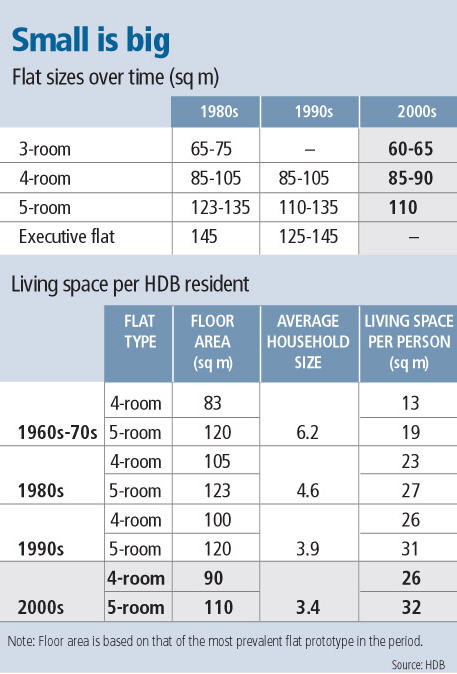
(SINGAPORE) HDB flats have gotten smaller over the years, but most occupants today should actually have more space to themselves as the size of families has also shrunk.
Data that BT obtained from HDB reflects this trend. From the 1980s to 2000s, all types of flats have been scaled down. The changes appear most noticeable between the 1990s and the 2000s.
For instance, a five-room flat built in the last 10 years would measure around 110 square metres, but an older one from the 1990s would be 110-135 sq m, while another hailing from the 1980s would measure some 123-135 sq m.
HDB explained that it 'reviews flat sizes regularly, taking into consideration changes in demographic trends and lifestyle habits, as well as the need to optimise limited land available for housing'.
Home hunters have noticed the change in flat sizes. The difference stands out particularly to those who have been shopping for resale flats across estates, said Dennis Wee Group director Chris Koh.
PropNex chief executive Mohamed Ismail agreed that flats have become smaller in the last 20 to 30 years, but pointed out that there has also been a more 'efficient use of space'.
For instance, most new flats no longer come with large balconies and long corridors. In addition, glass panels have become an increasingly common feature because they create a sense of spaciousness, he said.
While HDB's data confirms that flats have become more compact, it also highlights something less obvious to the casual observer - many residents today should have more living space because their families are smaller.
According to official surveys, the average household size was 3.4 in the 2000s and 4.6 in the 1980s. This means that an occupant in a relatively new 110 sq m five-room flat is likely to have 32 sq m of space to himself, while someone living in a 123 sq m five-roomer in the 1980s probably had just 27 sq m of space.
'Over the years, while flat sizes have been adjusted, living space per person has improved for HDB residents as household size has decreased . . . due to the nuclearisation of families and formation of smaller families,' HDB said.
HDB 'will continue to provide a wide variety of flats and ensure that flat sizes are reviewed regularly to cater to prevailing and future needs'.
Property agents note that flat sizes alone do not influence homebuyers' decisions - other factors such as location and amenities come into play.
As Mr Ismail shared, many people are looking forward to waterfront living in Punggol, even though flats in the area are likely to be smaller than those in older estates such as Yishun. 'The environments cater to different needs. There are pros and cons,' he said.
Still, industry watchers are not keen - and do not expect - to see flats getting smaller as they have to accommodate families.
'There's very little that you can cut back on, unless you want to cut back on the yard area . . . As it is, the room sizes are just nice,' Mr Koh said.
In the private housing sector, condominium units have also shrunk in size. The trend picked up pace from early 2009 when projects with a large proportion of shoebox units measuring less than 500 sq ft started to emerge. Developers have an incentive to keep units small so that they remain affordable even if prices in per square foot terms are high.
BT reported recently that the authorities have been projecting housing supply in the Government Land Sales programme by using smaller estimates for the average size of non-landed homes.
Market watchers do not believe that HDB flats will go the way of shoebox apartments. These private projects 'cater to investors who want to own a second property or to a single who wants to buy . . . but public housing is for a family nucleus', Mr Ismail said.
Source: www.businesstimes.com.sg
Housing a nation - today and tomorrow
by Mah Bow Tan
05:55 AM Dec 24, 2010
When Kit Chan performed Home at this year's National Day Parade, she struck a chord with many in the crowd, including me. This is my home. This is where people can "build our dreams together". This is what "will stay within me, wherever I may choose to go".
Over the last few months, in this series of articles, I have explained how the Government strives to foster a sense of home and belonging for all Singaporeans through a massive public housing programme. In this final column, let me sum up how the Housing & Development Board delivers this housing commitment in three ways: Homes for the masses, home ownership and homes for life.
HOUSING FOR HOMEBUYERS
Homes for the masses: The HDB builds and prices flats to achieve home ownership for the masses. Unlike some other countries where public housing caters to the poorest minority, the HDB's mission is to house the masses so that we can build an inclusive nation. But we face two growing challenges.
As we become a nation of home owners, demand from flat buyers - many with existing homes - has grown more volatile and sentiment-driven. Oversupply is as worrying as undersupply. Therefore, the HDB moved to the current Build-To-Order system, so that its new flat supply can respond to demand changes, while keeping a small buffer for contingencies.
As Singapore progresses, the people's aspirations are also rising and becoming more diverse. While standard flats will continue to form the bulk of new flat supply, the HDB has to build different flats for different budgets and aspirations, so that public housing remains an inclusive home for Singaporeans.
Home ownership: This is the second hallmark of our housing system. We provide homes for ownership, rather than for rent, so that Singaporeans have a clear stake in the country's prosperity. But even as flats appreciate in value to the benefit of home owners, housing must remain affordable for first-time buyers. The HDB therefore sets aside new BTO flats for first-timers and prices them at a substantial subsidy relative to market value. The HDB also provides housing grants for first-timers to buy resale flats. This helps to ensure affordability and equity in subsidies.
Today, nine in 10 residents own their HDB flats and about 15,000 young couples become home owners every year. Beyond international measures like the Home Price Index (HPI) and the Debt Service Ratio (DSR), our high ownership rate is the clearest indicator that flats remain affordable for first-timers. Most couples buying new flats use only 20 to 25 per cent of their monthly income through CPF contributions to pay for their housing loans, without any cash.
For the minority who cannot readily afford to own flats, public rental flats represent the final safety net. Even then, the HDB and social agencies strive to help these families improve their situations so that home ownership remains a long-term hope for them.
HOUSING FOR HOME OWNERS
Homes for life: The HDB takes a life-cycle approach to its relationship with residents. It helps young couples buy their first homes. It rejuvenates the homes and estates of the existing 900,000 home owners. It also helps older home owners right-size their homes for retirement while they remain staying within their community. Ultimately, HDB flats are not only homes but also an asset whose value can be unlocked, if needed.
Rejuvenating our homes: By 2015, more than 200,000 flats will be at least 30 years old. For older flats to remain attractive and sustain their value for home owners, the HDB embarked on a massive estate renewal programme since the '90s, focusing on Main Upgrading, Interim Upgrading, and Lift Upgrading (LUP).
Since 2007, estate renewal has taken on a larger dimension under the "Remaking Our Heartland" programme. This goes beyond upgrading works by HDB and pulls together efforts by different agencies to give an entire town a makeover. We will breathe new life into the heartlands by injecting new housing, rejuvenating town centres and developing new amenities and recreational areas. These include park connectors, cycling paths, heritage trails, and Active, Beautiful and Clean Water features.
In addition to enhancing the value of HDB flats, rejuvenation must focus on making towns more sustainable. Sustainability is about being able to use our land, energy and water more effectively as well as reducing waste. Punggol will be developed as our first eco-town. Lessons learnt there will be drawn for use in existing towns.
Right-sizing our homes: By 2030, one in five residents are expected to be aged 65 and above. Our HDB estates and policies must prepare for the different needs of elderly home owners. The HDB has begun to upgrade our physical environment to be more elder-friendly. All estates will be barrier-free by next year. The LUP is also on track to provide 100 per cent lift access to all eligible blocks by 2014.
As our population ages and family sizes shrink, Singaporeans may face less family support in their old age. Some may want to right-size and unlock their housing asset. HDB has put in place various options. Under the Lease Buyback Scheme, elderly home owners can receive a long-term income stream without uprooting from their surroundings. Elderly flat owners can also rent out spare rooms or whole flats for income, as their children grow up and move out. The elderly can also choose to right-size and buy studio apartments that are better equipped for their needs.
Building cohesive communities: Besides looking after individual home buyers and owners, the HDB's larger mission is to build cohesive communities. The HDB experience is an important part of the Singapore story where people of different backgrounds, ethnicities and incomes live harmoniously together as a community.
This is why the HDB spends considerable effort on planning our estates, down to the layout of blocks, precincts and neighbourhoods. HDB void decks, playgrounds and precinct pavilions are just some of the spaces carefully designed for residents to mix and mingle as part of their daily routine.
HOMES WHERE WE BELONG
When the HDB was formed in 1960, its pressing challenge then was to solve the huge housing shortage for Singaporeans. Fifty years on, the HDB has succeeded beyond expectations and received numerous international accolades for its achievements. I am thankful for the selfless contributions of the many men and women in the HDB through the years who have made it possible.
What about the next 50 years and beyond? Clearly, the focus of the HDB's challenge will evolve. Besides providing attractive and affordable flats for new homebuyers, the HDB's greater challenge will be to sustain the quality of life, community bonds and value that HDB flats bring to home owners, even as our estates mature.
While the challenges in the next phase will be different, the HDB's core mission of building homes and bringing hope of a better life for hardworking Singaporean families remains unchanged. With the continued support of other agencies, community leaders, and residents, I am confident that we can build an even better home for all - one where "we'll build our dreams together. Just like we've done before".
To all those who have followed this series of articles and given me comments, feedback and suggestions, let me say a sincere "thank you". I am also grateful to Today for providing me this platform to engage Singaporeans on this very important subject. Finally, I wish everyone season's greetings and a very happy and successful 2011.
The writer is the Minister for National Development. This is the last of nine commentaries that he has written exclusively for Today.
Source: www.todayonline.com
2010's last BTO project launched in Punggol
by S Ramesh
05:55 AM Dec 23, 2010
SINGAPORE - The Housing and Development Board (HDB) has launched its last Build-To-Order (BTO) project for this year, the Punggol Topaz, with 1,010 standard flats. With the launch yesterday, the HDB would have offered 17,713 new flats under the BTO and Sale of Balance Flat exercise this year.
Punggol Topaz, located along Punggol Way and Punggol Field, comprises 184 three-bedroom units, 542 four-bedroom and 284 five-bedroom flats, with 95 per cent of the flats set aside for first-timers. The facilities there will include a supermarket, an eating house, shops, a child care centre and a Residents' Committee Centre.
The Punggol MRT/LRT station, bus interchange and future town centre are nearby. Tampines Expressway and Kallang-Paya Lebar Expressway are a short drive away.
In line with the HDB's plans to develop Punggol as an eco-town, Punggol Topaz is designed for Green Mark Certification.
The layout of blocks and units is oriented to minimise heat gain from the sun. It will have features such as dry ponds and rain gardens, which help to maintain the quality of surface run-off from rainwater before it is discharged into the drainage system.
Selling prices for the flats range from $166,000 to $207,000 for three-bedroom units, $267,000 to $329,000 for four-bedroom and $335,000 to $406,000 for five-bedroom flats.
PropNex corporate communications manager Adam Tan said: "Compared with our transactions in PropNex for November 2010, the prices for the 4-room and 5-room flats in Punggol Topaz are 25 per cent and 19 per cent cheaper than prevailing resale prices."
Next year, the HDB is prepared to launch up to 22,000 new BTO flats, if demand is sustained. It will launch about 5,000 BTO flats - in towns such as Bukit Panjang, Jurong West, Yishun and Sengkang - in the first quarter.
The next BTO launch in January will offer 1,700 flats in Bukit Batok and Yishun.
Source: www.todayonline.com
HDB launches 1,010 BTO flats in Punggol
Published December 23, 2010
HDB launches 1,010 BTO flats in Punggol
By UMA SHANKARI
THE Housing & Development Board (HDB) yesterday launched another 1,010 new flats for sale in its latest build-to-order (BTO) project, Punggol Topaz.
Including this launch, HDB has now offered a total of 17,713 new flats for sale under its BTO and sale of balance flat exercises in 2010, it said.
And the agency will continue to roll out new supply at a steady rate next year. It plans to launch about 5,000 new BTO flats in the first quarter of 2011, including 1,700 flats in Bukit Batok and Yishun in January.
For the whole of 2011, HDB is prepared to launch up to 22,000 new BTO flats if demand is sustained, it said.
Punggol Topaz, located along Punggol Way and Punggol Field, comprises 184 three-room, 542 four-room and 284 five-room standard flats. Some 95 per cent of the flat supply will be set aside for first-timer households.
Selling prices range from $166,000 to $207,000 for a three-room flat; $267,000 to $329,000 for a four-room flat; and $335,000 to $406,000 for a five-room flat.
In line with HDB's plans to develop Punggol as an eco-town, Punggol Topaz is designed with eco-friendly features to receive Green Mark certification.
PropNex expects the attractive pricing of the flats to be the biggest pull factor for potential applicants.
Based on transactions handled by the property firm in November 2010, the prices for four-room and five-room flats in Punggol Topaz are 25 per cent and 19 per cent cheaper than prevailing resale prices.
'Despite the slight drop in median resale prices in Punggol since 3Q10, this still translates to a hefty price difference and greater affordability for the BTO flats in Punggol Topaz,' said PropNex corporate communications manager Adam Tan.
He expects strong demand for the new flats due to the current popularity of Punggol - even though the number of new flats introduced by HDB this year is at a high of almost 18,000.
Source: www.businesstimes.com.sg
BTO project in Punggol launched
BTO project in Punggol launched
By S Ramesh | Posted: 22 December 2010 1234 hrs
SINGAPORE: The Housing & Development Board (HDB) has launched another Build-To-Order (BTO) project - the Punggol Topaz with 1,010 standard flats - in Punggol.
HDB said 95 per cent of the flat supply would be set aside for first-timer households.
With the launch on Wednesday, HDB would have offered a total of 17,713 new flats for sale under the BTO and Sale of Balance Flat exercise in 2010.
Punggol Topaz, located along Punggol Way and Punggol Field, comprises 184 units of three-room, 542 units of four-room and 284 units of five-room flats.
Facilities to be provided at this development include a supermarket, an eating house, shops, a child care centre, and a Residents' Committee Centre.
Other facilities available in Punggol town to serve the future residents include the nearby Punggol MRT/LRT station, bus interchange, and the future town centre.
The Tampines Expressway (TPE) and Kallang-Paya Lebar Expressway (KPE) are a short drive away, offering good connectivity to the rest of Singapore.
In line with HDB's plans to develop Punggol as an Eco-Town, Punggol Topaz is designed for Green Mark Certification, with eco-friendly features.
The layout of blocks and units is oriented to minimise heat gain from the sun.
It is designed with ecologically friendly features such as dry ponds and rain gardens that help to maintain the quality of surface runoff from rainwater before it is discharged into the drainage system.
The selling prices for the flats range from S$166,000 to S$207,000 for a three-room flat, S$267,000 to S$329,000 for a four-room flat and S$335,000 to S$406,000 for a five-room flat.
For 2011, HDB said it is prepared to launch up to 22,000 new BTO flats, if demand is sustained.
In the first quarter of next year, HDB will launch about 5,000 BTO flats. These BTO flats will be located in towns such as Bukit Panjang, Jurong West, Yishun and Sengkang.
The next BTO launch in January 2011 will offer 1,700 flats in Bukit Batok and Yishun.
- CNA/wk
Source:/www.channelnewsasia.com
HDB's one-millionth flat milestone
Published December 20, 2010
HDB's one-millionth flat milestone
By JOYCE HOOI
(SINGAPORE) The keys to the Housing and Development Board's (HDB) one- millionth flat were handed to its owners yesterday, at the completion ceremony of Treelodge@Punggol.
The development is the first eco-friendly precinct developed under the auspices of the HDB, which celebrated its 50th anniversary in February this year.
'In just 50 years, the HDB has built one million flats to house a nation. This is no mean feat, and few other countries can lay claim to such an outstanding achievement in so short a time,' said Teo Chee Hean, Deputy Prime Minister and Minister for Defence, during his speech as the ceremony's guest-of- honour.
Mr Teo is also an MP for the Pasir Ris-Punggol Group Representation Constituency (GRC).
The Treelodge@Punggol features an eco-deck above the carpark, a playground built from recyclable materials, and a rainwater collection system, among other things.
Residents will also have a car sharing scheme at their disposal, which will include hybrid cars as well.
An additional centralised refuse chute for recyclables has been introduced for each block, in order to promote more waste recycling.
'It's something new. There were no other HDB flats that were indicated as eco-friendly then, and we were quite excited to get it,' said Christina Ng, the owner of the one-millionth flat, a four-room unit.
Ms Ng and her husband, Wang Weiji, balloted for the flat in 2007 and are first-time homeowners. They plan to move in after the Chinese New Year.
The development was launched in 2007 with seven blocks of 712 flat units in total, comprising three-, four-, and five-room flats.
Year-to-date, 3,300 new flats have been launched in Punggol by the HDB and another 1,000 new flats are due to be launched over the next few days.
'If demand remains strong, HDB is on track to complete 35,000 flats by the end of 2015,' said Mr Teo.
Last month, the HDB launched the tender for the first mixed commercial-residential site at Punggol Town Centre, which will be next to the Punggol Waterway and Punggol MRT station.
'The HDB story is also the story of hope and social mobility in Singapore,' said Mr Teo.
'Singaporeans know that if they work hard and budget wisely, they can aspire to upgrade to a better flat and a better life.'
In 2008, the HDB won the United Nations Public Service Award for its Home Ownership Programme.
This was followed by the UN-Habitat Scroll of Honour Award 2010, which was given to the HDB for 'providing one of Asia's and the world's greenest, cleanest, and most socially conscious housing programmes'
Source: www.businesstimes.com.sg

