BARTLEY Terrace, the residential area at 16 Gambir Walk, has been sold for $40 million through a private treaty that was sealed on Jan 17. The deal was brokered by Urban Front Real Estate.
The property, which is situated near Bartley MRT and Maris Stella High School, was sold to Meadows Investment, which is owned by Neo Tiam Boon, executive director of property and construction firm Tiong Aik Group. With a land area of about 40,482 square feet (sq ft) and a plot ratio of 1.4, the gross floor area works out to 56,674.8 sq ft.
The price for the site amounts to about $760 per square foot per plot ratio, taking into account an estimated $3 million development charge with 10 per cent balcony that the developer may have to pay.
Talks for the collective sale started in the middle of last year for the District 19 freehold site, and bids for the tender closed at the end of last year. Thereafter, the deal went into private negotiation. The owners of each of the 32 units at Bartley Terrace will stand to receive sales proceeds that range from $1.14 million to $1.8 million. The majority owners are applying to the Strata Titles Board for a sale order
Published January 28, 2011
Source; www.businesstimes.com.sg
Bartley Terrace sold for $40 million
Dilemma for genuine home buyers
Some wonder if they should wait and see if the recent cooling measures push down prices significantly
by Ong Teck Hui
05:55 AM Jan 28, 2011
The Government's latest round of measures to cool the residential property market was clearly targeted at short-term investors and speculators.
Effective since Jan 14, they include the highly punitive stamp duties which apply to the resale of residential properties within four years of purchase, the reduced loan limit of 60 per cent for buyers with one or more outstanding mortgages, as well as the 50-per-cent loan limit for buyers who are non-individuals, for example companies and trusts.
It would appear that the measures have been applied to slow down the market to avoid the growth of a property bubble, as well as to allow genuine buyers the opportunity to purchase their dream homes without runaway prices.
Genuine home buyers do form a significant demand pool, and many have planned to make their purchases in the near term. The introduction of the fresh measures has led them to wonder whether prices would soften and whether it might be worth their while to wait. Some are hoping for a substantial price correction, "maybe 20 per cent or more", before deciding to buy.
SEEING PRICE DECLINES IN PERSPECTIVE
But would the residential property market correct by that magnitude - 20 per cent or more - due to the measures alone? It would be useful for us to analyse past declines in prices to arrive at an informed conclusion on the price outlook.
The most recent price correction in the residential property market was due to the economic recession arising from the global financial crisis. From the peak in mid-2008 to trough in mid-2009, prices softened by 25 per cent, according to the Urban Redevelopment Authority's residential property price index. The impact of the new measures will certainly be nowhere as catastrophic as that of the global financial crisis.
Another benchmark is the decline in prices following the announcement of the anti-speculation measures in May 1996. The very harsh measures, which included a 20-per-cent upfront downpayment in cash for all property purchases and taxes on gains from properties sold within three years of purchase, affected the entire residential market, bringing transaction volumes down by 75 per cent. Prices eased by 8.9 per cent over a one-year period before being dragged down by a further 40 per cent by the Asian financial crisis.
In contrast, the current measures have been calibrated to discourage shorter-term investors and speculators, leaving genuine home buyers relatively unaffected.
Barring external shocks or economic downturns, the measures by themselves are unlikely to drag prices down significantly, if at all. Under the present positive market conditions, sellers are on a stable footing and under no pressure to slash prices.
BUYERS' IMPATIENCE
After the set of measures announced on Aug 30 last year, potential buyers retreated to the sidelines to watch how the residential market would pan out.
Last August, developers launched 1,165 units and sold 1,259. What potential buyers saw was a slightly slower market in September, with 1,058 units launched and 911 sold. Activity in October picked up, with 1,070 units launched and 1,066 sold, but that was the month when two new executive condominiums (ECs) were launched, generating much hype and interest. Including ECs, 2,049 units were launched in October and 1,596 sold.
The market also watched developers' response to the sale of residential sites. Tenders for mediocre residential and EC sites were met with fair response and cautious bids, while the more attractive sites saw strong competitive bidding.
The URA's property price index for 3Q2010 showed that residential property prices rose 2.9 per cent, although it would have captured primarily pre-measures pricing. Market behaviour and evidence would have led most potential buyers to conclude that the residential market was holding up well against the measures, transactional activity was resuming and prices were unlikely to soften.
By November, the residential property market picked up with a vengeance with several major launches and good take-up. Including ECs, 2,331 units were launched and 2,092 sold, making November almost the busiest month last year. The December figures for homes launched and sold (including ECs) were lower at 1,859 and 1,699, respectively, but this was expected as it was the typical year-end holiday period.
When the 4Q2010 price index was released, it showed residential property prices continuing to climb by 2.7 per cent, notwithstanding the effect of the measures. It only served to confirm potential buyers' fear that prices would continue to rise.
TO WAIT OR NOT TO WAIT?
Potential buyers' behaviour over the next few months would determine the direction of the residential property market for the rest of this year. If buying sentiment recovers in the short term, transactional activity would pick up, leading to firm prices with, perhaps, some upside. However, if the market slows without an improvement in sentiment, prices could eventually soften.
The dilemma that many genuine home buyers face is whether to continue with their intended purchases or to hold off in the hope that prices will correct significantly.
It would be worthwhile waiting if prices do eventually decline substantially, but delaying also runs two main risks: Higher interest rates and stronger measures imposed by the Government that may affect even genuine home buyers. On the other hand, higher interest rates and stronger Government measures could result in price softening, but that would mean postponing one's purchase even longer.
Historical experience may show that prices are unlikely to correct significantly due to measures such as those recently introduced. But it is what potential home buyers believe or perceive that will drive their behaviour, which will, in turn, influence the market.
The residential property market may have been jolted by the Jan 14 measures, but market fundamentals remain favourable. Together with inflation concerns, the current low interest rates and expectations of long-term capital appreciation, it appears that buyers would likely be drawn back to the residential property market after an expected period of hesitation.
Ong Teck Hui is executive director of research and consultancy at Credo Real Estate.
Source: www.todayonline.com
DBSS site at Clementi launched for sale
Published January 26, 2011
DBSS site at Clementi launched for sale
By UMA SHANKARI
THE Housing and Development Board (HDB) has launched a site at Clementi Avenue 4 for sale under its design, build and sell scheme (DBSS).
An estimated 770 flats can be built on the plot, which has a site area of 235,800 square feet and a maximum allowable gross floor area of 825,300 sq ft. The site carries a lease term of 103 years (including a four-year construction period).
Analysts expect a top bid in the range of $200-$250 per square foot per plot ratio (psf ppr) for the plot. This translates to an overall land cost of $165 million to $206 million.
'This is one of the more attractive sites offered under the DBSS scheme,' said Nicholas Mak, head of research at SLP International. 'It is close to Clementi MRT station. Clementi New Town is also becoming more vibrant, with new projects such as The Clementi Mall.'
While buying sentiment has significantly moderated in both the public and private housing sectors, participation from developers for this site is likely to be motivated by the project's physical strengths and opportunities, said Ong Kah Seng, Cushman & Wakefield senior manager of Asia-Pacific research.
'This site is likely to see moderate interest from developers, who are still interested in providing homes for this specific segment although generally, home-buying sentiments are expected to remain cautious in the months ahead,' Mr Ong said.
The last site offered for sale under the DBSS scheme, at Yuan Ching Road in Jurong, drew a top bid of $192 psf ppr. Six bids were submitted for the site.
The tender for this site will close at noon on March 8, 2011.
Last year, HDB sold five land parcels for DBSS development in Yishun, Bedok, Tampines, Hougang and Jurong West. These five land parcels will yield about 3,000 DBSS flats, and this pipeline supply will come on-stream progressively in 2011.
Another DBSS site at Pasir Ris Central, with an estimated yield of 460 units, will be launched for tender in March. More sites for DBSS development will be made available if there is sustained demand, HDB added.
Flats sold under DBSS are offered to buyers under HDB's eligibility conditions. But the developers who buy such sites have some flexibility in designing, pricing and selling the flats.
Source: www.businesstimes.com.sg
Some rush to close property deals, some back out
by Joanne Chan
05:55 AM Jan 15, 2011
SINGAPORE - The latest round of cooling measures introduced by the Government, which kicked in today, appears to have created some knee-jerk reaction in the private property market.
MediaCorp understands that some sellers rushed to close deals before midnight to avoid the new rules. Others have pulled their properties from the market.
Property firms told MediaCorp that they have received many enquiries from prospective buyers and sellers after news of the new restrictions broke on Thursday.
First-time private property buyer Christopher Ng, 36, was rushed by his agent into making an offer for a house last night, as the seller wanted to close the deal quickly. However, Mr Ng was pipped to the deal by another buyer.
Mr Ng added: "My other agents actually called me and said that most of the listings have been delisted and so the supply has shrunk."
Dennis Wee Group director Chris Koh said he knew of a buyer who immediately exercised the option to purchase, once the news of the new measures were announced.
The seller's stamp duty has been raised to a maximum of 16 per cent on property sold within the first year, a steep jump from the previous 3 per cent.
Banks will also reduce the maximum loan they extend to those who already have one or more mortgages to 60 per cent of the property value.
While other property analysts felt it was premature to assess the full impact of the measures, Propnex CEO Mohd Ismail said he expects 20 per cent of buyers who had bought properties recently to rethink their transactions.
Buyers who have paid a deposit but do not exercise the option to purchase might forfeit the fees - amounting to 1 per cent of the property's value - which they have paid.
Source; www.todayonline.com
Loft@Holland units snapped up
Updated 11:12 AM Jan 14, 2011
SINGAPORE - Only hours before the Government announced its latest round of cooling measures for the property market, buyers had snapped up all the units available at the Loft@Holland, Oxley Holdings' latest "shoebox'' residential project.
The property developer said all its 41 units were sold within two hours at its soft launch yesterday. Demand was so strong that all, but two units, in the development needed balloting to be conducted.
"On average, there were about three interested buyers per unit," Oxley said.
The units were sold at between $1,630 to $2,166 per sq ft, and most of the buyers were mainly locals, the company said.
Oxley chairman and chief executive officer Ching Chiat Kwong said: "The market's overwhelming response to our latest projects is extremely encouraging."
The five-storey development which is located at 151, Holland Road, comprises 37 one-bedroom units, ranging from 323 sq ft to 484 sq ft, and four two-bedroom penthouses with private jacuzzis, ranging from 980 sq ft to 1,141 sq ft.
It also has common facilities that include a basement carpark, a swimming pool and a gymnasium.
Analysts believe that the main attraction of the property is its prime location, which puts it in close proximity to the proposed Holland Village MRT Station and nearby Holland Village Shopping Centre.
It is also close to renowned schools like Henry Park Primary School, Nanyang Primary School, and Hwa Chong Institution.
Loft@Holland is expected to receive its Temporary Occupation Permit in December 2015.
Source: www.todayonline.com
Lay down the cooling measures to be taken upfront
by Colin Tan
Updated 11:11 AM Jan 14, 2011
In a Sunday feature article entitled "History-making year ahead", eight events and issues were highlighted by the writer which are expected to loom large in 2011. Seventh on the list was how to cool the property market without crashing it.
Last year, private housing prices eclipsed the previous 1996 peak, while the cash-over-valuation (COV) levels for public flats reached historic highs even as the Government unveiled two sets of cooling measures and ramped up the supply of housing sites and the number of new public flats for sale. It was a tumultuous year to say the least.
While the events in the property market may not be as central as the General Election and Presidential Polls listed as first and second on the list, it has the potential to significantly affect the results of the two.
Fortunately, the impact of the most recent set of cooling measures appears to have yielded results for the time being at least.
Flash estimates released by the Urban Redevelopment Authority (URA) recently show that private housing prices edged up by only 2.7 per cent in Q4, down from 2.9 per cent in Q3, albeit taking the price index to a fresh high.
However, sales volumes have not dampened. Over 15,500 new private homes are estimated to have been sold last year - a new benchmark.
Over at the HDB market, prices of resale flats rose 2.4 per cent in Q4 2010 - a slower rate of growth than the 4 per cent increase in Q3 2010. But while the resale price index was pushed to yet another all-time record, transaction volumes fell.
The resale volume declined by about 21 per cent in Q4. The median COV amount is also estimated to have fallen by $7,000 or 23 per cent, from $30,000 in Q3 to $23,000 in Q4 2010. But prices of public housing resale flats are still going up.
With the region awash with liquidity and healthy economic growth, the upward trend of the property market is expected to continue in 2011.
The finalised set of market numbers will determine whether a new round of cooling measures is forthcoming.
However, even if prices remain stable, if sales of new homes continue to be very high, then the concern is that a lot of it may not be owner-occupier demand. This has strong ramifications for the rental market. If the cost of borrowings should suddenly shoot up, a crash cannot be ruled out even if our track record shows that we have always managed a soft landing.
To outsiders who are not familiar with our housing market, all of our current market indicators, including those on the economic front, are gelling together to produce what can be considered to be the perfect property bull run if there is such a thing.
It is a sign of the anxious times, when single-property owners have mixed feelings even as many are made millionaires on paper.
Personally, I am not so sure the effects of the latest set of cooling measures will last. Our housing market must be among the most open and attractive to investors all over the world.
Is it time for some measures regulating the amount of liquidity flowing into Singapore and into the local housing market? Can there be more focused cooling measures without affecting genuine buyers and sellers? Is it time to pool together all the data of all the various government bodies to get to the bottom of the "problem" if it has not already been done yet?
It is very difficult to suggest solutions if there are still big gaps on what we know about the market. If the gap persists should not there be greater efforts to plug them?
Much as I like speculators to learn from their mistakes, a crash benefits no one.
Personally, I am not in favour of changing the goal posts midway with respect to investors. It breeds uncertainty and affects investor confidence. As I see it, part of the problem is that the market does not appear to take the Government's warning - that it will not let the market overheat - seriously. Either that or it has short memories.
I prefer a more direct approach. Lay down all the cooling measures to be taken upfront. Have four sets, one for each quarter. Set the trigger points for each of them, say x per cent rise in the price index. If the price index surpasses this figure, the first set of cooling measures automatically kicks in and so on. The trigger points can be linked to fundamentals, say the percentage GDP growth for the previous quarter plus x per cent.
This should send a very clear message to investors. At the same time, the market has a choice; whether it wants to trigger the measures or not.
Colin Tan is head, research and Consultancy, at Chesterton Suntec International.
Source: www.todayonline.com
More developers see higher prices for new home launches
Published January 13, 2011
More developers see higher prices for new home launches
Property market's Future Sentiment Index rose to 5.7 in Q4 from 4.8 in Q3
By EMILYN YAP
(SINGAPORE) Developers' outlook for the property sector turned rosier in the fourth quarter last year, with a larger proportion of them predicting higher prices for new residential launches.
Preliminary findings from the Real Estate Sentiment Index (RESI) point to improved sentiment from the third quarter, when the industry was still coming to terms with the impact of property market cooling measures introduced on Aug 30.
Steven Choo, CEO of the Real Estate Developers' Association of Singapore (Redas), gave a preview of RESI results for Q4 at a seminar yesterday. Redas and the National University of Singapore's Department of Real Estate jointly developed RESI.
Based on survey responses so far, the Current Sentiment Index stood at 5.6 in Q4, up from 4.8 in Q3. For this category, respondents rate overall Singapore real estate market conditions now compared with six months ago.
The Future Sentiment Index - where respondents rate overall property market conditions over the next six months - rose to 5.7 in Q4 from 4.8 in Q3.
'We've actually seen a rebound,' Mr Choo said. 'We think it is an accurate reflection of our members' take on the market.'
While the index readings rose in Q4, they did not surpass the levels seen in Q1 and Q2.
Developers were also asked for their take on the primary residential market, and a majority of the respondents thought more launches and moderate price increases were possible.
In Q4, 60 per cent of respondents believed that unit prices would be moderately higher. In Q3, just 12 per cent thought so.
Some 76 per cent of respondents in Q4 also expected moderately or substantially more units to be launched, compared with 44 per cent in Q3.
A developer, who declined to be named, suggested that good take-up for several big launches in Q4 buoyed sentiment. Spottiswoode Residences, Waterview and Robinson Suites were some which reported strong sales.
Some industry watchers also reckoned that the sector's confidence grew as the impact of the tightening measures became clearer.
A Hong Leong spokesman told BT: 'While we took a cautious outlook immediately following the August 2010 cooling measures, buyer demand continued to remain strong for the group's various projects.' Low interest rates and liquidity in the market contributed to the demand, he said.
Credo Real Estate managing director Karamjit Singh also said: 'Like with any announcement, it takes at least a month or two for the dust to settle.'
Even so, improved optimism does not mean that the measures had no effect - there is still 'a sense of caution in the air', he stressed.
In the ongoing Q4 RESI survey, 69 per cent of respondents identified demand-side measures from the government as a potential risk to market sentiment.
Although this proportion is less than Q3's 83 per cent, it is still big enough to make state intervention the second most feared risk.
A possible slowdown in the global economy was the industry's top worry - 70 per cent of respondents said in Q4 that this was a potential risk. This is markedly higher than the 56 per cent a quarter ago
Source: www.businesstimes.com.sg

The Nassim, d'Leedon units to be launched
CapitaLand Residential expects continued demand, price rises for private residential housing
by Jo-Ann Huang Limin
05:55 AM Jan 10, 2011
SINGAPORE - CapitaLand Residential will sell 1,700 private residential units this year out of its existing inventory of 2,500 ready-to-launch homes that it has yet to release for sale, chief executive officer Wong Heang Fine said in his first presentation to the media.
The units that will be sold this year will be from some of CapitaLand Residential's most high-profile developments, such as d'Leedon, The Interlace, Urban Resort and The Nassim, said Mr Wong, who joined the CapitaLand Group in 2006 and was named in July last year to succeed Ms Patricia Chia as CEO of CapitaLand Residential.
As many as 750 units of the 1,715-unit d'Leedon, the former Farrer Court, will be launched this year. MediaCorp understands that another 300 units will be launched next week, after 93 per cent of the initial 250 units launched last month were sold.
The residential unit of CapitaLand, South-east Asia's largest property developer, will also release the remaining 390 apartments at The Interlace for sale this year, Mr Wong, a UK-trained mechanical engineer who was formerly the CEO of SembCorp Engineers and Constructors, said in his briefing. The developer has sold 94 per cent of the initial 650 units that it launched last year.
The Urban Resort and The Nassim, which are luxury developments located in the core central region, will also be launched this year.
Homes at the new Bedok Town Centre site will also be up for grabs. The site will be developed into a mixed retail-and-residential property with 500 apartments, three levels of retail space and a bus interchange.
CapitaLand sold 15,025 units in total in the first 11 months last year, a marginal increase from the 14,688 units sold in 2009. But the developer reported better per-unit sales value than its rivals - its average sales value amounted to $2.3 million per unit, higher than the industry average of $1.52 million per unit. Overall, total residential sales rose 54 per cent to $1.85 billion last year, compared with $1.2 billion in 2009.
In the first 11 months of last year, buyers took possession of 629 CapitaLand homes, including 127 units at Latitude, 327 apartments at The Seafront on Meyer and 175 units at The Orchard Residences.
CapitaLand expects demand for private residential housing to sustain this year, buoyed by robust economic performance, land scarcity and increasing wealth in the region.
It will also be a year of land banking for the developer. The company said it would continue looking at sites in city-fringe areas and near MRT stations. It may tap both the government land sales programme and the collective sale market to acquire land, Mr Wong said.
"We will, of course, bid for the sites at a price we think is consistent with our margin," said Mr Liew Mun Leong, chief executive officer of CapitaLand, who was also present at the media briefing.
CapitaLand expects private home prices to increase by 5 to 10 per cent this year, with the high-end residential segment experiencing gains in the region of 10 to 15 per cent.
The developer also aims to market its iconic projects such as d'Leedon and The Interlace overseas, especially to buyers from China and India, which are emerging as CapitaLand's key new foreign markets.
Foreign buying may become a sizeable chunk of CapitaLand's sales. For example, wealthy Chinese investors have been looking for homes priced at $10 million and above, said Mr Liew.
However, market watchers have expressed concern over foreign ownership and its increasing influence on the private property market in Singapore.
Mr Liew believes that any further Government measures to cool the property market should not target foreign buyers.
"Singapore is an open economy and it will have to attract professionals and expatriates," he said. "I will consider it unprogressive to say that foreigners cannot buy housing here," he added.
Source: www.todayonline.com
CapitaLand to launch 1,700 mostly upmarket homes
Published January 10, 2011
CapitaLand to launch 1,700 mostly upmarket homes
It expects prices of high-end units to rise 10-15% this yr
By UMA SHANKARI
(SINGAPORE) Property group CapitaLand will launch around 1,700 new homes in Singapore this year as it plans to ride on an expected 10-15 per cent growth in high-end home prices.
'We remain bullish about (the prospects of) the residential market in Singapore, particularly for the segment our products are in,' said Wong Heang Fine, chief executive of CapitaLand's Singapore residential arm. He was speaking to reporters on Friday at a briefing on the unit's prospects.
CapitaLand expects private home prices to rise by a further 5-10 per cent in 2011 after they climbed 17.6 per cent in 2010. But for the high-end segment, the outlook is even brighter; the group's view is that prices in that segment could climb by 10-15 per cent this year.
This should benefit the developer, which plans to roll out another 1,700 mostly upmarket units in five different projects - The Nassim, Urban Resort Condominium, The Interlace, d'Leedon and the residential component of a new development at Bedok Town Centre - in 2011.
With the exception of the Bedok Town Centre development, the remaining four projects will all be high-end or luxury offerings.
CapitaLand has already started marketing The Nassim and Urban Resort Condominium, but will officially launch both projects in Q1 2011.
At the freehold Urban Resort Condominium, 14 out of the 64 units available have been sold as at end-November 2010, data from the Urban Redevelopment Authority (URA) shows. CapitaLand expects to sell the remaining units for upwards of $3,000 per square foot (psf) each.
Sales at The Nassim, a 55-unit project at Nassim Hill on the former ANA Hotel site, have yet to start. CapitaLand declined to provide the expected pricing for the project, but said that units in other developments in the area are selling for $3,500 psf and more.
The group will also roll out more units in two developments it launched in 2009 and 2010 - The Interlace and d'Leedon - in Q1 2011. This will be followed by units in a mixed-use project at Bedok Town Centre on the site CapitaLand bought in a government tender in 2010. That project could be launched in the second or third quarter of 2011.
CapitaLand is also looking to replenish its land bank, said the group's chief executive Liew Mun Leong. He said that the group was interested in sites made available by the H1 2011 government land sales programme as well as collective sale sites.
The property group is coming off a strong 2010. Last year, CapitaLand sold 800 homes in Singapore, 33 per cent more than the 600 homes sold in 2009. The total value of sales also rose 54 per cent year-on-year to $1.85 billion.
CapitaLand shares lost 2 cents to close at $3.88 on Friday
Source: www.businesstimes.com.sg
Bishan residential site up for tender
Published January 8, 2011
Bishan residential site up for tender
By EMILYN YAP
THE Housing & Development Board will be launching a 99-year leasehold residential site at Bishan Street 14 for tender in about two weeks' time.
Consultants expect to see as many as eight bidders for the plot, which is located near Bishan MRT station.
The 1.2 ha site on the reserve list, with a maximum gross floor area of 632,764 square feet, can yield an estimated 590 condominium units.
An unnamed developer triggered the sale when it committed to pay at least $189.8 million or $300 per square foot per plot ratio (psf ppr).
The plot is within walking distance of Bishan MRT station and Junction 8 shopping mall. It is also near several education institutions - ITE College Central (Bishan) is next door while Raffles Institution is a few streets away. A few other parcels of state land surround the site.
Cushman & Wakefield senior manager of Asia-Pacific research Ong Kah Seng believes that the top bid might come in at $450-480 psf ppr, which could translate to selling prices of $920-950 psf.
According to caveats lodged with the authorities, units at Bishan 8 nearby went for $852-955 between August and October last year.
There is likely to be moderate demand from developers because of the site's location, Mr Ong said. The winning developer will get a headstart in offering condominiums in that area, and could potentially acquire the surrounding plots when the government includes them in the land sales programme, he added.
SLP International Property Consultants' research executive director Nicholas Mak expects some of the higher bids to reach $460-530 psf ppr.
Although many residential sites on the confirmed list will be rolled out for sale in the first half of this year, this plot at Bishan remains attractive because of its location, he said.
Besides, mass-market homes should continue to enjoy demand even if price growth may be limited this year, he added.
Source: www.businesstimes.com.sg
For sale: two housing plots, industrial site
Published January 6, 2011
For sale: two housing plots, industrial site
Kaki Bukit tender in 2 weeks; Whitley Heights, Residence 81 go en bloc
By EMILYN YAP
THE new year has brought with it a slew of residential and industrial sites for developers to invest in.
Two private home developments are up for collective sale. One is the freehold Whitley Heights, located off Whitley Road, which occupies a land area of 130,165 square feet.
The owners are asking for $185-210 million, which works out to around $1,421-1,613 per square foot (psf) of land area.
Whitley Heights is more than 20 years old and has 45 walk-up apartments in three three-storey blocks. Under the 2008 Master Plan, the site is designated for two-storey mixed landed houses upon redevelopment.
This means that the buyer can choose to build a combination of conventional terraces, semi-detached and detached houses, strata terraces, strata semi-detached houses and strata bungalows.
Credo Real Estate is handling the tender for Whitley Heights, which closes on Jan 26. It notes that the project could be the first site with an area of more than 100,000 sq ft to be sold en bloc for landed development in more than three years.
According to Credo, the buyer could build as many as 80 strata terrace houses or around 60 strata semi-detached houses on the site.
'Supply for landed sites has been few and far between,' said Credo managing director Karamjit Singh. 'The dearth of supply can only result in price escalation for landed homes.'
Credo found that from 2000 to 2010, barely 4,000 units were added to the stock of landed homes, leading to an increase of less than 6 per cent.
As a result, the stock of landed housing as a proportion of all private residential homes has dropped to 27 per cent last year from 35 per cent in 2000.
Over at Telok Kurau, the freehold Residence 81 is up for auction with an indicative price of around $25.1 million, which translates to $950 psf of strata floor area.
The five-year-old property has a single owner and will be sold with vacant possession. BT understands that the owner is part of the Hotel 81 group, and the sale is the result of a property portfolio reorganisation.
Residence 81 sits on a site measuring 15,455 sq ft and has a total strata floor area of 26,446 sq ft. There are 21 strata-titled units, of which two on the ground floor have been reconfigured into a communal area.
Colliers International is handling the auction, scheduled for Jan 19. According to its deputy managing director Grace Ng, the buyer can apply for naming rights for the development and put the individual units up for sale.
The buyer can also rent the units out. 'Leasing demand is expected to stay robust in 2011, partly supported by the projected increase in hiring, especially by financial institutions,' she said. 'Rents for private residential homes can be expected to climb further by 8 to 12 per cent on average in 2011.'
While the sale process is just beginning for some home owners, residents of Maison Royale have bagged $46 million for their freehold estate in Newton. The buyer, Giant Land, may have to pay another $2.55 million in development charge, leading to an overall price of around $1,230 psf per plot ratio (psf ppr).
In the industrial sector, an unnamed developer has committed to pay at least $18 million or $68 psf ppr for a 30-year leasehold state land parcel at Kaki Bukit Road 4.
The 2.45-hectare site on the reserve list, zoned for Business 2 development, will be launched for tender in two weeks' time
Source: www.businesstimes.com.sg

Australia the next property investment hot spot?
by Jo-Ann Huang Limin
05:56 AM Dec 31, 2010
SINGAPORE - Australian real estate may present a good investment opportunity next year as a robust economy and a growing shortage of homes underpin prices that, according to analysts, have room to go up still further.
Analysts say that foreigners will be drawn to the market, with Chinese, Singaporean and Malaysian buyers continuing to lead demand. Despite restrictions on foreign buyers of Australian properties, Asian investors are still snapping up homes Down Under, especially in major cities such as Sydney and Melbourne.
"Foreigners do have restrictions. When they are selling, they have to sell to Australian nationals, but this doesn't seem to affect people," said Mr Julian Sedgwick, senior associate director for international residential sales at real estate agency Savills.
He said there were 800 enquiries received at Savills over a recent weekend for two or three property launches in Sydney.
"We sold about 25 per cent of the units from one such property and as many as 10 per cent to 15 per cent of the buyers are Asian," he said.
Prices of Australian homes have risen 56 per cent in the past 10 years. Yet the Housing Industry Association in Australia estimates that the price-to-income ratio is slightly lower today than it was in December 2007.
And options for home buyers are not limited to Sydney and Melbourne. With prices in these two cities reaching record levels - an inner-city one-bedroom home in Sydney currently commands up to A$750,000 ($984,000) - analysts say that it may be worthwhile for foreign home buyers to shift their attention to a city such as Brisbane, where prices are relatively lower.
To ward off the threat of asset bubbles, Australian policy-makers raised interest rates to 4.75 per cent last month.
But analysts say this will not put off Asian investors. Singaporeans, for example, can finance their Australian properties with loans pegged to a lower interest rate.
"We can actually borrow in Singapore dollars, so as a result our interest rate is about 1.5 per cent to 2 per cent," said Ms Donna Lim, head of overseas projects at HSR International Realtors.
For apartments in the central business district, "you probably would be able to get 6 per cent to 7 per cent, for houses in the suburbs you will probably enjoy 5 per cent rental return; so there's definitely a positive cash flow here," she added.
Due to high foreign demand and a lack of new housing supply in key Australian cities, market watchers expect property prices to rise as much as 8 per cent next year. An index of home prices in Australia's eight capital cities was 5.7-per-cent higher in the three months ended this September, compared with the final quarter of 2009.
Source: www.todayonline.com
Clear the hogwash and whitewash
Wishes for next year: More market transparency and independent views in the property sector
by Colin Tan
05:55 AM Dec 31, 2010
When I was a student, I believed everything I read in the papers. If it appeared in print, it had to be true. When I did my stint as a reporter, I realised that not every bit of important information we gathered came out in print. Sometimes, alternative or opposing views just did not go well with the story flow.
These days, I advise my student interns not to believe everything they read and to be discerning, more so now than in the past, as there is a lot more "noise" in the market these days. While reporters used to hassle news-makers for information, a lot more information is pushed to the media these days.
Marketing views seem to predominate nowadays. Higher-priced properties are automatically classified as prime housing or as belonging to the luxury segment. An 800 sq ft or even a 1,600 sq ft unit, no matter how exquisitely finished, cannot qualify as a luxury unit. If you tell a foreigner from one of the developed economies that you have just purchased one such "luxury" unit, they will have a different notion of what you own. If you then tell them it is only 800 sq ft, they will break into laughter.
Small units in the Central Business District are also not prime apartments. A more accurate description would be inner-city apartments.
Doubled-storeyed top floor units are also not automatically penthouses. A 1,600 sq ft unit split into two floors atop a block in a private housing project is definitely not a penthouse - it is a maisonette. And there are no penthouses in the HDB resale sector, no matter what the agents say. A penthouse is almost always a luxury unit.
This week, an agent described the rising vacancy levels in one of the property segments as a "short-term statistical blip". If there is a short-term blip, should there not be a long-term blip? A blip is a result that goes against the trend in just one outcome. If it carries on for four quarters, it is a trend and no longer a blip.
Monthly data such as developers' sales should not just be compared against the result in the previous month. Or else, it will be good, bad, good, bad, ad infinitum. It should be compared against a monthly average. A year-on-year comparison is better if the market is seasonal in nature.
The time horizon for buying ahead of the curve should be restricted to one property cycle, which may be five years or seven years depending on the market segment. It makes no sense rushing to buy a project next to a future MRT station or in an emerging area if it is coming up only 10 years later or more. It would make better sense to wait to buy during the lowest point of the cycle.
Predicting an interest rate hike within the next five years is not worth the paper it is printed on. Even a student can do that.
And a report predicting a rental increase of 30 per cent over three years is not news; it amounts to an average of only 10 per cent each year.
Lately, I have seen some industry heads taking to publishing their own guide books. Browse around the bookshops and you will find them. Some pointers in these books are useful, while others are less so - and even misleading if you are not careful.
Schematic location maps of some future private housing projects also confuse more than they enlighten. The purpose, it appears, is to show as many amenities and attractions in "close proximity" to the project rather than the actual location. I sometimes have to refer to the street directory to find the project's actual location. I feel these developers not only do a disservice to buyers but also to themselves as they lose credibility in the long run.
Finally, I wish for more independent debate on property matters for next year. In this respect, I hope more academicians and economists will contribute their views to the media. Imagine how much more enlightening for the public as well as policy-makers if there are more insightful views on matters such as housing affordability and on the effectiveness of actual and potential cooling policy measures.
The writer is Head, Research & Consultancy, at Chesterton Suntec International.
Source: www.todayonline.com
Honey, I shrunk the flat, but it's just us now
Honey, I shrunk the flat, but it's just us now
HDB flats are smaller than before but may provide more space as families shrink
By EMILYN YAP
Top Print Edition Stories
Published December 30, 2010
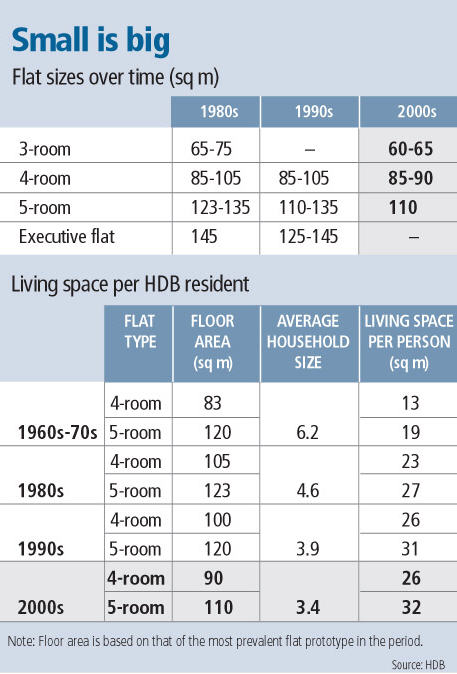
(SINGAPORE) HDB flats have gotten smaller over the years, but most occupants today should actually have more space to themselves as the size of families has also shrunk.
Data that BT obtained from HDB reflects this trend. From the 1980s to 2000s, all types of flats have been scaled down. The changes appear most noticeable between the 1990s and the 2000s.
For instance, a five-room flat built in the last 10 years would measure around 110 square metres, but an older one from the 1990s would be 110-135 sq m, while another hailing from the 1980s would measure some 123-135 sq m.
HDB explained that it 'reviews flat sizes regularly, taking into consideration changes in demographic trends and lifestyle habits, as well as the need to optimise limited land available for housing'.
Home hunters have noticed the change in flat sizes. The difference stands out particularly to those who have been shopping for resale flats across estates, said Dennis Wee Group director Chris Koh.
PropNex chief executive Mohamed Ismail agreed that flats have become smaller in the last 20 to 30 years, but pointed out that there has also been a more 'efficient use of space'.
For instance, most new flats no longer come with large balconies and long corridors. In addition, glass panels have become an increasingly common feature because they create a sense of spaciousness, he said.
While HDB's data confirms that flats have become more compact, it also highlights something less obvious to the casual observer - many residents today should have more living space because their families are smaller.
According to official surveys, the average household size was 3.4 in the 2000s and 4.6 in the 1980s. This means that an occupant in a relatively new 110 sq m five-room flat is likely to have 32 sq m of space to himself, while someone living in a 123 sq m five-roomer in the 1980s probably had just 27 sq m of space.
'Over the years, while flat sizes have been adjusted, living space per person has improved for HDB residents as household size has decreased . . . due to the nuclearisation of families and formation of smaller families,' HDB said.
HDB 'will continue to provide a wide variety of flats and ensure that flat sizes are reviewed regularly to cater to prevailing and future needs'.
Property agents note that flat sizes alone do not influence homebuyers' decisions - other factors such as location and amenities come into play.
As Mr Ismail shared, many people are looking forward to waterfront living in Punggol, even though flats in the area are likely to be smaller than those in older estates such as Yishun. 'The environments cater to different needs. There are pros and cons,' he said.
Still, industry watchers are not keen - and do not expect - to see flats getting smaller as they have to accommodate families.
'There's very little that you can cut back on, unless you want to cut back on the yard area . . . As it is, the room sizes are just nice,' Mr Koh said.
In the private housing sector, condominium units have also shrunk in size. The trend picked up pace from early 2009 when projects with a large proportion of shoebox units measuring less than 500 sq ft started to emerge. Developers have an incentive to keep units small so that they remain affordable even if prices in per square foot terms are high.
BT reported recently that the authorities have been projecting housing supply in the Government Land Sales programme by using smaller estimates for the average size of non-landed homes.
Market watchers do not believe that HDB flats will go the way of shoebox apartments. These private projects 'cater to investors who want to own a second property or to a single who wants to buy . . . but public housing is for a family nucleus', Mr Ismail said.
Source: www.businesstimes.com.sg
181 Soho units at The Tennery sold
Published December 29, 2010
By UMA SHANKARI
FAR East Organization has sold 181 Soho-style (small office, home office) apartments in its 338-unit The Tennery.
The developer said yesterday that it released 217 units of its newest residential project, at Bukit Panjang, in a preview. A total of 181 units were sold at prices ranging from $950 per sq ft (psf) to $1,300 psf.
The 99-year leasehold The Tennery is part of an integrated residential and retail development Far East is building on the Ten Mile Junction site it won in a government tender in February.
Far East paid $164 million or $437 psf per plot ratio for the site at the junction of Choa Chu Kang and Woodlands roads.
In addition to The Tennery, the site will also house a 121,000 sq ft retail development called Junction 10.
Some 80 per cent of The Tennery's buyers are Singaporeans and permanent residents, Far East said. It added that most of the buyers are professionals living in the Bukit Panjang, Choa Chu Kang, Bukit Batok and Hillview areas, who are familiar with the neighbourhood.
Far East Organization's executive director and chief operating officer Chia Boon Kuah said that an increasing number of people are looking for versatile living spaces that allow them to work from home.
This development, he said, is flexible, expandable and designed for maximum functionality.
The Tennery's one-bedroom apartments range from 619 sq ft to 640 sq ft in size, while two-bedders range from 860 sq ft to 950 sq ft in size. Far East will release more units during the project's official launch on Jan 1, 2011.
In 2010, including The Tennery, Far East has launched nine residential projects in Singapore. Other launches included Altez in the Tanjong Pagar area, The Greenwich at Seletar Hills and Skyline@Orchard Boulevard
Source: www.businesstimes.com.sg

High-end condos can't keep pace with mass-market hikes
Published December 29, 2010
High-end condos can't keep pace with mass-market hikes
Prices in Non-Central region top pre-crisis high, Central region 3.7% below peak
By KALPANA RASHIWALA
(SINGAPORE) The latest flash estimates for November from the National University of Singapore (NUS) show that prices of non-landed private homes in Singapore's Central region (districts 1-4 and 9-11) have appreciated 7.9 per cent in the first 11 months of this year from end-2009.
Over the same period, the Singapore Residential Price Index (SRPI) sub-index for the Non-Central region rose at a faster clip of 12.9 per cent. As a result, the overall SRPI increased 10.7 per cent year to date.
SRPI, compiled by the NUS Institute of Real Estate Studies, covers only completed properties.
The Central region sub-index for November is still 3.7 per cent shy of its pre-Global Financial Crisis peak in November 2007. On the other hand, the sub-index for the Non-Central region in November has already surpassed its January 2008 pre-crisis peak by 15 per cent. As a result, the overall November 2010 index is about 7.6 per cent above its November 2007 pre-crisis high.
The latest indices from NUS tally with what property agents have been reporting from the ground - that mass-market condo prices have scaled fresh records this year while prices of prime and luxury condos have yet to touch their 2007 records.
DTZ executive director (consulting) Ong Choon Fah said that entry-level suburban condos have enjoyed strong demand this year, riding on upgrader demand amid a buoyant HDB resale market.
'In addition, the trend of developing a higher proportion of smaller units in private residential projects has spread from the prime districts (where rental demand is stronger) to the suburbs - and this has also helped to boost sales of mass-market projects by making the lump sum investment more palatable to buyers.'
Mrs Ong also pointed out that these days, developers of suburban projects are offering some of the innovative features which in the past were available only in prime district projects - such as sky gardens.
Knight Frank chairman Tan Tiong Cheng said that the increase in high-end condo prices had not been so sparkling this year due to more subdued foreign buying compared with the previous bull run in 2007.
'The foreign buying back then was from a wider spectrum. These days, buyers from the West, Middle East and Russia seem to be out of the equation. Also Western bankers were a significant buying contingent in 2007 but post-crisis, banks are less generous with remuneration.'
Month on month, the overall SRPI dipped 0.2 per cent in November. The sub-index for the Non-Central region too eased 0.3 per cent but the Central region sub-index was flat.
Since the last round of property cooling measures on Aug 30, the Central region sub-index has eased 0.4 per cent while the non-Central index has strengthened 0.9 per cent. As a result, the overall index in November was 0.4 per cent ahead of the August level.
Despite being proven wrong with their earlier forecast of stronger price appreciation for high-end condos compared to mass-market ones for 2010, analysts continue to predict the same trend in 2011, pointing to the already substantial price hikes posted in the mass-market segment. And if the government succeeds in taming HDB resale prices, that will also have an impact on upgrader demand for entry-level condos. Also, any interest rate hike, as well as further property cooling measures, is likely to make a bigger dent on demand in the mass-market segment than on upmarket condos
Source: www.businesstimes.com.sg

A mild collective sale fever
Published December 28, 2010
A mild collective sale fever
Most of the en bloc sales this year transacted at less than $50 million each, writes NICHOLAS MAK
THE residential en bloc or collective sales market in Singapore is picking up again in 2010 after taking a hiatus last year. To date, some 30-odd en bloc sales amounting to about $1.6 billion have been successfully concluded.
Meng Garden Apartments: With just 27 units, the project at Lloyd Road fetched $137m in an en bloc sale, the largest transacted this year. During the height of the boom in 2007, the average en bloc sale value was $119.3m
However, unlike the en bloc sales fever of 2005 to 2007, the size of each collective sales transacted in 2010 was smaller by comparison.
Most of the collective sales of residential developments transacted this year were less than $50 million each. The average value of each deal was about $52.6 million.
The largest collective sale transacted in 2010 was that of the 27-unit Meng Garden Apartments at Lloyd Road, which was sold for $137 million. By comparison, the average value of each collective sale that was concluded during the height of the previous property market boom in 2007 was $119.3 million.
The size, in terms of land area and the number of existing apartments, of each collective sale that was transacted in 2010 was also smaller. The average land area of the collective sales properties concluded in 2010 is about 36,000 sq ft, which is dwarfed by the average 105,000 sq ft of land of the en bloc sales in 2007.
Typically, about 94 per cent of the successful collective sale developments in 2010 consisted of less than 50 existing units. The average size is about 22 existing units in each project.
By contrast, the average number of existing units of the successful collective sale projects in 2007 is about 3.5 times larger.
The prime residential areas also witnessed fewer collective sales this year. Only about one-fifth of the successful en bloc sale developments in 2010 were located within the prime Districts 9, 10 and 11. The total transacted value of these en bloc projects in the prime districts added up to $678 million.
A significant number of collective sales projects were situated in the city-fringe areas, such as Districts 12 and 14. In 2007, the prime districts held about half of the 104 successful collective sales.
Government land sales
These prime district en bloc sales properties had a combined transacted value of some $8.5 billion.
One of the reasons for the smaller and fewer collective sales in 2010 is that many of the bigger developments in the prime districts and the popular East Coast region that could potentially be collective sales projects were already sold to developers in 2005 to 2007.
A second reason is that the flood of development sites from the Government Land Sale (GLS) programme for 2010, especially for the second half of this year, had attracted the attention and resources of many developers.
In response to the increase in housing demand and prices in 2009 and 2010, in the second half of 2010, the Singapore government released the largest supply of residential development land in the past 15 years. The 18 land parcels to be sold through the Confirmed List in H2, 2010 could potentially yield 8,300 housing units. In addition, there are another 13 sites on the Reserve List that could be developed into 6,000 homes.
So far this year, the authorities have sold 20 private 99-year leasehold residential sites amounting to $3.63 billion and another eight executive condominium (EC) sites that fetched $1.32 billion. This is not including the 14 smaller land parcels at Sembawang designated for landed housing that were auctioned off for $134.6 million in October.
In total, the government's residential land sales in 2010 had absorbed about $5.1 billion of funds from developers, which is more than three times the amount that developers spent on private en bloc sales.
Some developers prefer to acquire GLS sites because the process is faster and more transparent. In almost all government land tenders, all the names of the bidders and their respective bids are revealed hours after the close of the tender.
By comparison, property agents who conduct en bloc sales are never known to reveal the list of bidders and their bids in the same manner as the government.
Furthermore, once the highest bid exceeded the government's reserve price, the authorities would usually award the site to the highest bidder within a week after the close of the tender.
By comparison, some en bloc sales can be long drawn-out dramas, including protracted litigations, especially if some of the owners objected to the en bloc sale strongly or the estate agents had made some administrative mistakes.
Another reason why developers have been drawn to GLS tenders is the market segment that has enjoyed the most robust sales in the past two years is the mass market.
Condominium projects that are located near MRT stations are highly popular with homebuyers, provided they are priced reasonably. Developers are only too aware of this fact and there is a good selection of such land parcels in the recent GLS programmes.
The type of land that developers will buy would depend on the type of products that they are confident that they can sell at an attractive profit margin. The present trend of developers preferring small en bloc projects could continue into the first half of 2011.
This is because there are few indications that the sale volume in the high-end residential market would surge in the next few months.
In the past eight months, the sales volume of private homes in the prime districts had been relatively lacklustre as they made up less than one-fifth of the total number of private homes sold by developers.
On average, between April and November this year, 224 housing units in the Core Central Region (CCR) were sold in the primary market each month, while developers sold an average of 486 units and 642 units in the city-fringe and suburban regions respectively.
Furthermore, the asking price of the owners of the collective sales projects are unlikely to soften as they factor in the rising replacement cost of their new homes. Most collective sales could take months to conclude. And during that period, home prices could continue to rise.
But some developers may be turned away by the high asking prices as they could acquire the relatively cheaper GLS sites. Ironically, the very market forces that drive the en bloc sales market could also derail some of the potential deals.
Mega deals
In January 2011, four collective sales tenders are scheduled to close, including those with reserve prices exceeding $600 million each. It is an uphill task to successfully conclude such mega deals mainly because it would require the developer to put many of his eggs in one basket.
With a budget of $600 million, the developer could possibly acquire three to four GLS sites or 12 smaller en bloc sales sites, thereby diversifying his risks.
Each of the 20 GLS private condominium sites were sold by the government in 2010 for an average of about $181.4 million, while a large majority of collective sales in 2010 were transacted below $50 million each.
In addition, there is the risk of more cooling measures by the government in 2011. Any new government intervention is likely to further target property investors, while sparing first-time homebuyers.
And since a significant proportion of the high-end property buyers are investors and very few first-time homebuyers can afford luxury properties, any new property market curbs by the government is likely to affect the mid-tier and high-end segments.
However, there are also some major developers who are interested to acquire freehold trophy sites to add to their land bank.
But they are rather selective and the total land price, including the development charge that is payable to the government, is just one of the key selection criteria for the land parcels to be purchased.
In the coming year, there will be more collective sales attempts as some property owners try to cash in on the rising market.
In the face of such eagerness to sell, it is quite probable that one or two mega en bloc sales could be concluded in 2011.
However, the en bloc sales market in 2011 is unlikely to reach the red hot level of 2007.
Nicholas Mak is executive director (research & consultancy), SLP International Property Consultants
Source: www.businesstimes.com.sg

Housing a nation - today and tomorrow
by Mah Bow Tan
05:55 AM Dec 24, 2010
When Kit Chan performed Home at this year's National Day Parade, she struck a chord with many in the crowd, including me. This is my home. This is where people can "build our dreams together". This is what "will stay within me, wherever I may choose to go".
Over the last few months, in this series of articles, I have explained how the Government strives to foster a sense of home and belonging for all Singaporeans through a massive public housing programme. In this final column, let me sum up how the Housing & Development Board delivers this housing commitment in three ways: Homes for the masses, home ownership and homes for life.
HOUSING FOR HOMEBUYERS
Homes for the masses: The HDB builds and prices flats to achieve home ownership for the masses. Unlike some other countries where public housing caters to the poorest minority, the HDB's mission is to house the masses so that we can build an inclusive nation. But we face two growing challenges.
As we become a nation of home owners, demand from flat buyers - many with existing homes - has grown more volatile and sentiment-driven. Oversupply is as worrying as undersupply. Therefore, the HDB moved to the current Build-To-Order system, so that its new flat supply can respond to demand changes, while keeping a small buffer for contingencies.
As Singapore progresses, the people's aspirations are also rising and becoming more diverse. While standard flats will continue to form the bulk of new flat supply, the HDB has to build different flats for different budgets and aspirations, so that public housing remains an inclusive home for Singaporeans.
Home ownership: This is the second hallmark of our housing system. We provide homes for ownership, rather than for rent, so that Singaporeans have a clear stake in the country's prosperity. But even as flats appreciate in value to the benefit of home owners, housing must remain affordable for first-time buyers. The HDB therefore sets aside new BTO flats for first-timers and prices them at a substantial subsidy relative to market value. The HDB also provides housing grants for first-timers to buy resale flats. This helps to ensure affordability and equity in subsidies.
Today, nine in 10 residents own their HDB flats and about 15,000 young couples become home owners every year. Beyond international measures like the Home Price Index (HPI) and the Debt Service Ratio (DSR), our high ownership rate is the clearest indicator that flats remain affordable for first-timers. Most couples buying new flats use only 20 to 25 per cent of their monthly income through CPF contributions to pay for their housing loans, without any cash.
For the minority who cannot readily afford to own flats, public rental flats represent the final safety net. Even then, the HDB and social agencies strive to help these families improve their situations so that home ownership remains a long-term hope for them.
HOUSING FOR HOME OWNERS
Homes for life: The HDB takes a life-cycle approach to its relationship with residents. It helps young couples buy their first homes. It rejuvenates the homes and estates of the existing 900,000 home owners. It also helps older home owners right-size their homes for retirement while they remain staying within their community. Ultimately, HDB flats are not only homes but also an asset whose value can be unlocked, if needed.
Rejuvenating our homes: By 2015, more than 200,000 flats will be at least 30 years old. For older flats to remain attractive and sustain their value for home owners, the HDB embarked on a massive estate renewal programme since the '90s, focusing on Main Upgrading, Interim Upgrading, and Lift Upgrading (LUP).
Since 2007, estate renewal has taken on a larger dimension under the "Remaking Our Heartland" programme. This goes beyond upgrading works by HDB and pulls together efforts by different agencies to give an entire town a makeover. We will breathe new life into the heartlands by injecting new housing, rejuvenating town centres and developing new amenities and recreational areas. These include park connectors, cycling paths, heritage trails, and Active, Beautiful and Clean Water features.
In addition to enhancing the value of HDB flats, rejuvenation must focus on making towns more sustainable. Sustainability is about being able to use our land, energy and water more effectively as well as reducing waste. Punggol will be developed as our first eco-town. Lessons learnt there will be drawn for use in existing towns.
Right-sizing our homes: By 2030, one in five residents are expected to be aged 65 and above. Our HDB estates and policies must prepare for the different needs of elderly home owners. The HDB has begun to upgrade our physical environment to be more elder-friendly. All estates will be barrier-free by next year. The LUP is also on track to provide 100 per cent lift access to all eligible blocks by 2014.
As our population ages and family sizes shrink, Singaporeans may face less family support in their old age. Some may want to right-size and unlock their housing asset. HDB has put in place various options. Under the Lease Buyback Scheme, elderly home owners can receive a long-term income stream without uprooting from their surroundings. Elderly flat owners can also rent out spare rooms or whole flats for income, as their children grow up and move out. The elderly can also choose to right-size and buy studio apartments that are better equipped for their needs.
Building cohesive communities: Besides looking after individual home buyers and owners, the HDB's larger mission is to build cohesive communities. The HDB experience is an important part of the Singapore story where people of different backgrounds, ethnicities and incomes live harmoniously together as a community.
This is why the HDB spends considerable effort on planning our estates, down to the layout of blocks, precincts and neighbourhoods. HDB void decks, playgrounds and precinct pavilions are just some of the spaces carefully designed for residents to mix and mingle as part of their daily routine.
HOMES WHERE WE BELONG
When the HDB was formed in 1960, its pressing challenge then was to solve the huge housing shortage for Singaporeans. Fifty years on, the HDB has succeeded beyond expectations and received numerous international accolades for its achievements. I am thankful for the selfless contributions of the many men and women in the HDB through the years who have made it possible.
What about the next 50 years and beyond? Clearly, the focus of the HDB's challenge will evolve. Besides providing attractive and affordable flats for new homebuyers, the HDB's greater challenge will be to sustain the quality of life, community bonds and value that HDB flats bring to home owners, even as our estates mature.
While the challenges in the next phase will be different, the HDB's core mission of building homes and bringing hope of a better life for hardworking Singaporean families remains unchanged. With the continued support of other agencies, community leaders, and residents, I am confident that we can build an even better home for all - one where "we'll build our dreams together. Just like we've done before".
To all those who have followed this series of articles and given me comments, feedback and suggestions, let me say a sincere "thank you". I am also grateful to Today for providing me this platform to engage Singaporeans on this very important subject. Finally, I wish everyone season's greetings and a very happy and successful 2011.
The writer is the Minister for National Development. This is the last of nine commentaries that he has written exclusively for Today.
Source: www.todayonline.com
HDB's one-millionth flat milestone
Published December 20, 2010
HDB's one-millionth flat milestone
By JOYCE HOOI
(SINGAPORE) The keys to the Housing and Development Board's (HDB) one- millionth flat were handed to its owners yesterday, at the completion ceremony of Treelodge@Punggol
The development is the first eco-friendly precinct developed under the auspices of the HDB, which celebrated its 50th anniversary in February this year.
'In just 50 years, the HDB has built one million flats to house a nation. This is no mean feat, and few other countries can lay claim to such an outstanding achievement in so short a time,' said Teo Chee Hean, Deputy Prime Minister and Minister for Defence, during his speech as the ceremony's guest-of- honour.
Mr Teo is also an MP for the Pasir Ris-Punggol Group Representation Constituency (GRC).
The Treelodge@Punggol features an eco-deck above the carpark, a playground built from recyclable materials, and a rainwater collection system, among other things.
Residents will also have a car sharing scheme at their disposal, which will include hybrid cars as well.
An additional centralised refuse chute for recyclables has been introduced for each block, in order to promote more waste recycling.
'It's something new. There were no other HDB flats that were indicated as eco-friendly then, and we were quite excited to get it,' said Christina Ng, the owner of the one-millionth flat, a four-room unit.
Ms Ng and her husband, Wang Weiji, balloted for the flat in 2007 and are first-time homeowners. They plan to move in after the Chinese New Year.
The development was launched in 2007 with seven blocks of 709 flat units in total, comprising three-, four-, and five-room flats.
Year-to-date, 3,300 new flats have been launched in Punggol by the HDB and another 1,000 new flats are due to be launched over the next few days.
'If demand remains strong, HDB is on track to complete 35,000 flats by the end of 2015,' said Mr Teo.
Last month, the HDB launched the tender for the first mixed commercial-residential site at Punggol Town Centre, which will be next to the Punggol Waterway and Punggol MRT station.
'The HDB story is also the story of hope and social mobility in Singapore,' said Mr Teo.
'Singaporeans know that if they work hard and budget wisely, they can aspire to upgrade to a better flat and a better life.'
In 2008, the HDB won the United Nations Public Service Award for its Home Ownership Programme.
This was followed by the UN-Habitat Scroll of Honour Award 2010, which was given to the HDB for 'providing one of Asia's and the world's greenest, cleanest, and most socially conscious housing programmes'
Source; www.businesstimes.com.sg

More price upside for luxury homes: Analysts
by Jo-Ann Huang Limin
05:55 AM Dec 17, 2010
SINGAPORE - More top-end condominiums in the core central region (CCR) have been changing hands - at higher prices - with each passing month. Yet, deals above $4,000 psf are still rare. Analysts say that this shows the luxury segment still has room for capital appreciation.
November saw only one such transaction - a Scotts Square unit which sold for $4,358 psf, according to the Urban Redevelopment Authority (URA). In October, a Boulevard Vue unit sold for $4,800 psf.
Back in 2007, a unit at Orchard Residences went for as high as $5,094 psf, while one at the Marque on Paterson Hill fetched $5,262 psf. In all, 13 units sold at higher than $4,000 psf in the second half of 2007. So far, in the second half of this year, there have been only five such sales.
Investors are still not paying top dollar for extra exclusivity - a sign that they have been cautious on luxury homes in the current property cycle. Prices of mass-market homes, meanwhile, have already surpassed their 2007 peaks.
Even then, analysts say it's only a matter of time before prices of luxury properties catch up with - and exceed - their 2007 peak.
"There's room to grow a further 5 to 8 per cent to reach 2007 price levels," said Dr Chua Yang Liang, head of research, South-east Asia at Jones Lang LaSalle.
Sales of new luxury homes have also been volatile, according to the URA's data. Sales in the CCR in November fell to 213 from 335 units in October. In September, following the government's Aug 30 measures to cool the property market, CCR sales were as low as 84 units.
But investors need not worry about the erratic sales volumes, analysts say.
"Luxury property sales tend to see some volatility because there are fewer luxury property developments compared with mass market ones," said Dr Chua. "High-end property developers launch their projects more sporadically."
With China clamping down hard on the property market in its tier-one cities, ultra-rich investors are likely to move capital to Singapore, analysts say.
"High-end residential properties in Singapore, which traditionally enjoy significant foreign home buying interest, may benefit as a number of investors from across the world are looking at diversifying their investments geographically," said Mr Ong Kah Seng, senior manager of research at Cushman & Wakefield.
Credit Suisse says investors should exit the residential real-estate market in China and move their money to the residential and commercial property markets in Singapore, Hong Kong and Japan.
The bank expects residential property prices in Singapore to increase 5 per cent in each of the next two years, on top of an estimated 15 per cent gain this year.
Still, analysts warn that the policy risk going into next year remains high for all types of properties, including luxury units that are typically unscathed by measures that seek to curb leveraged home-buying.
They said harsher cooling measures may be introduced - such as a tax on profits from property sales after URA data this week showed that 1,909 private residential units were sold last month,a surprising 80 per cent jump from October's 1,058 units.
Source: www.todayonline.com

