Published January 17, 2011
Shoebox units in industrial projects gaining currency
Downsizing aimed at residential property investors thwarted by curbs
By KALPANA RASHIWALA
(SINGAPORE) The instant success of shoebox residential units has drawn some developers to adopt the same strategy for industrial projects - to target investors and speculators thwarted by restrictions on trading in residential properties introduced over the past year.
The trend, visible even before the authorities' latest measures last Thursday to cool the sizzling private housing market, is now expected to gain further momentum.
While smallish industrial strata-titled units have been available in the Singapore market for some time, industry observers say at least one developer - the Oxley Holdings group, which has been active in developing shoebox apartments - is now branching into developing small-format strata industrial units for sale.
Other developers, such as Soilbuild and Chui Teng, are also expected to launch projects with such units for sale in the next few months.
Shoebox apartments have sold like hot cakes over the past 18 months because of their affordable lumpsum investment quantum, and Oxley is said to be banking on the same strategy for industrial property. It plans to offer about 750 strata factory/warehouse units with an average size of about 1,000 square feet for its project in Ubi Road 1. These units will be priced at about $500,000.
The proposed scheme is subject to approval from the Urban Redevelopment Authority (URA). BT understands that URA typically approves strata industrial projects with unit sizes of at least 100 square metres (1,076 sq ft), although sources say that in certain locations, types of development and designs, the minimum size allowed could be even lower at about 80 sq m (861 sq ft).
A URA spokeswoman said the planning authority 'generally does not prescribe a minimum size for industrial units in order to give developers the flexibility to cater to the different needs of industrialists'.
'However, there is a need to ensure that the layout and configuration of industrial units are capable of effectively functioning as meaningful spaces for industrial activities (for example, manufacturing and warehousing).
'Where it is unclear how a proposed layout is going to cater to industrial activities, URA will work closely with the developer and architect to better understand their development proposal and, if necessary, refine and improve the layout of the development to facilitate the intended industrial activity. This will also help to ensure that the space is not illegally converted to other uses,' she added.
Oxley's proposed 10-storey project in Ubi is said to comprise four blocks and could also feature condo- type facilities such as a gym and rooftop swimming pool. It is located near Tai Seng MRT Station.
The project will come up on a 60-year leasehold plot that Oxley bought for a whopping $169 per sq ft per plot ratio (psf ppr) at a state tender which closed last August.
Market watchers estimate Oxley's breakeven cost for the project could be about $400 psf and that it could market the units for about $500 psf on net saleable area. The 375,150 sq ft plot is zoned for 'Business 1' use.
The lumpsum investment of about $500,000 per unit is similar to the entry-price for shoebox apartments and could draw investors who do not wish to be constrained by the restrictions when investing in residential properties, said Ong Choon Fah, head of consulting & research, SE Asia, at DTZ.
Agreeing, Colliers International director (industrial services) Tan Boon Leong noted that, unlike those who invest in private homes, investors in strata industrial units do not have to pay a seller's stamp duty if they flip the property within specified periods.
In addition, those dabbling in industrial property investment may borrow up to 80 per cent of their property values (as opposed to 50-60 per cent for residential investors), depending on whether they are companies, trusts or individuals.
There are also no restrictions against HDB flat owners who are barred from owning a private property during the HDB flat's five-year minimum occupation period.
The returns are relatively attractive. 'Yields on 60-year industrial units can be about 6-8 per cent - higher than the sub-4 per cent for residential,' said Mr Tan.
Soilbuild is expected to launch in the first half a 60-year leasehold ramp-up factory development at Yishun Street 23 with about 500 units; some will be large (above 10,000 sq ft) but the majority about 1,500-2,000 sq ft and could be priced around the $500,000 mark on average, say sources. Chiu Teng is expected to retrofit Kallang Bahru Complex into a project with more than 150 light industrial units of around 1,000-1,500 sq ft, BT understands.
Colliers' Mr Tan says small-format industrial units appeal not just to investors but end-users. 'They may buy a few adjoining units and knock down the walls for a larger contiguous area.'
Source: www.businesstimes.com.sg
Shoebox units in industrial projects gaining currency
Loft@Holland units snapped up
Updated 11:12 AM Jan 14, 2011
SINGAPORE - Only hours before the Government announced its latest round of cooling measures for the property market, buyers had snapped up all the units available at the Loft@Holland, Oxley Holdings' latest "shoebox'' residential project.
The property developer said all its 41 units were sold within two hours at its soft launch yesterday. Demand was so strong that all, but two units, in the development needed balloting to be conducted.
"On average, there were about three interested buyers per unit," Oxley said.
The units were sold at between $1,630 to $2,166 per sq ft, and most of the buyers were mainly locals, the company said.
Oxley chairman and chief executive officer Ching Chiat Kwong said: "The market's overwhelming response to our latest projects is extremely encouraging."
The five-storey development which is located at 151, Holland Road, comprises 37 one-bedroom units, ranging from 323 sq ft to 484 sq ft, and four two-bedroom penthouses with private jacuzzis, ranging from 980 sq ft to 1,141 sq ft.
It also has common facilities that include a basement carpark, a swimming pool and a gymnasium.
Analysts believe that the main attraction of the property is its prime location, which puts it in close proximity to the proposed Holland Village MRT Station and nearby Holland Village Shopping Centre.
It is also close to renowned schools like Henry Park Primary School, Nanyang Primary School, and Hwa Chong Institution.
Loft@Holland is expected to receive its Temporary Occupation Permit in December 2015.
Source: www.todayonline.com
Honey, I shrunk the flat, but it's just us now
Honey, I shrunk the flat, but it's just us now
HDB flats are smaller than before but may provide more space as families shrink
By EMILYN YAP
Top Print Edition Stories
Published December 30, 2010
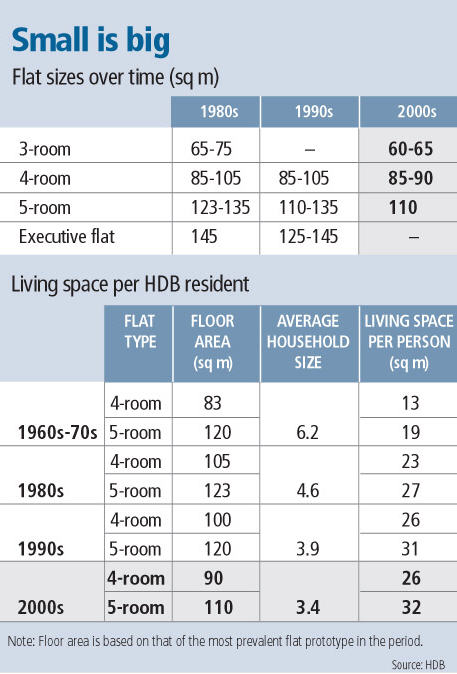
(SINGAPORE) HDB flats have gotten smaller over the years, but most occupants today should actually have more space to themselves as the size of families has also shrunk.
Data that BT obtained from HDB reflects this trend. From the 1980s to 2000s, all types of flats have been scaled down. The changes appear most noticeable between the 1990s and the 2000s.
For instance, a five-room flat built in the last 10 years would measure around 110 square metres, but an older one from the 1990s would be 110-135 sq m, while another hailing from the 1980s would measure some 123-135 sq m.
HDB explained that it 'reviews flat sizes regularly, taking into consideration changes in demographic trends and lifestyle habits, as well as the need to optimise limited land available for housing'.
Home hunters have noticed the change in flat sizes. The difference stands out particularly to those who have been shopping for resale flats across estates, said Dennis Wee Group director Chris Koh.
PropNex chief executive Mohamed Ismail agreed that flats have become smaller in the last 20 to 30 years, but pointed out that there has also been a more 'efficient use of space'.
For instance, most new flats no longer come with large balconies and long corridors. In addition, glass panels have become an increasingly common feature because they create a sense of spaciousness, he said.
While HDB's data confirms that flats have become more compact, it also highlights something less obvious to the casual observer - many residents today should have more living space because their families are smaller.
According to official surveys, the average household size was 3.4 in the 2000s and 4.6 in the 1980s. This means that an occupant in a relatively new 110 sq m five-room flat is likely to have 32 sq m of space to himself, while someone living in a 123 sq m five-roomer in the 1980s probably had just 27 sq m of space.
'Over the years, while flat sizes have been adjusted, living space per person has improved for HDB residents as household size has decreased . . . due to the nuclearisation of families and formation of smaller families,' HDB said.
HDB 'will continue to provide a wide variety of flats and ensure that flat sizes are reviewed regularly to cater to prevailing and future needs'.
Property agents note that flat sizes alone do not influence homebuyers' decisions - other factors such as location and amenities come into play.
As Mr Ismail shared, many people are looking forward to waterfront living in Punggol, even though flats in the area are likely to be smaller than those in older estates such as Yishun. 'The environments cater to different needs. There are pros and cons,' he said.
Still, industry watchers are not keen - and do not expect - to see flats getting smaller as they have to accommodate families.
'There's very little that you can cut back on, unless you want to cut back on the yard area . . . As it is, the room sizes are just nice,' Mr Koh said.
In the private housing sector, condominium units have also shrunk in size. The trend picked up pace from early 2009 when projects with a large proportion of shoebox units measuring less than 500 sq ft started to emerge. Developers have an incentive to keep units small so that they remain affordable even if prices in per square foot terms are high.
BT reported recently that the authorities have been projecting housing supply in the Government Land Sales programme by using smaller estimates for the average size of non-landed homes.
Market watchers do not believe that HDB flats will go the way of shoebox apartments. These private projects 'cater to investors who want to own a second property or to a single who wants to buy . . . but public housing is for a family nucleus', Mr Ismail said.
Source: www.businesstimes.com.sg
A penchant for shoebox housing
by Ong Kah Seng 05:54 AM Dec 17, 2010
Gone are the days where size matters for home seekers. Smaller apartments are making their presence. In the public housing sector, 3-room and studio flats have been re-introduced in new Build-to-Order HDB projects, while new private residential offerings seem to be increasingly smaller, yet popular.
Colloquially referred to as "Mickey Mouse" or "shoebox" apartments, there has been an increased demand for such residential units. The year 2007 saw a spike in sales of units smaller than 500 sq ft, from an almost inexistence to 325 units.
The story continued from there, to 883 transactions last year. While it can be argued that last year was a recession year and therefore small apartments found favour among financially cautious buyers, the heightened interest in shoebox units this year seems to confirm the growing penchant for smaller apartments. This year, a total of 1,421 such units have so far been transacted.
Why the popularity?
To examine why shoebox units have become popular, one must look at the private residential sector in the form of sales activity, pricing trends and product offerings in recent times.
The private residential sector has created various market participants who entered and exited at the right time to achieve tidy profits, reflecting success stories from property transactions. This spurred many other aspiring private home buyers to quickly proceed with a purchase.
However, while one recognises the opportunity from property investments, there are often limitations in one's financing capabilities. Gaining entry into the property game is but a dream unless one has accumulated sufficient funds to make a purchase.
Shoebox apartments are hence a feasible option for interested participants who find it increasingly difficult to own a sizeable piece of private property as prices have continued to escalate. For one, the upfront capital and overall cost of shoebox apartments are smaller and more affordable.
For another, the cost of a shoebox apartment will at most be comparable to that of a larger HDB flat. For a private residential property owner, there is more flexibility in home ownership and re-selling his unit.
Developers who saw this trend were quick in pushing out such projects amid the scarcity. The response has been encouraging and the resale demand for such properties has further reflected the overwhelming interest.
Understanding Challenges
Potential buyers of shoebox apartments need to know that the tenant base for such housing is more restricted than ordinary apartments. Prospective tenants are likely to have significant budget constraints and are often either local professionals or junior expatriates on partial housing allowances.
Some of these tenants may also prefer an HDB flat as it is more spacious for a rent that is lower than that of a shoebox apartment. Companies are unlikely to accommodate upper-middle and senior expatriates in shoebox apartments, who have specific housing requirements. A shoebox apartment will not reflect well on the company, which may in turn affect career and relocation decisions.
Also, living in a shoebox apartment may not be entirely cost effective. Some occupiers may find that there are limited activities within the confined space and prefer hanging out, incurring more entertainment expenses. The real costs of living may be higher than expected.
Relevance for shoebox apartments
Although there are challenges in investments, it does not necessarily reduce the appeal of shoebox apartments. As home buyers are becoming cautious and refraining from buying apartments beyond their reach, shoebox apartments can be smaller, realistic purchases that minimise liquidity risks. Buyers are also able to channel the rest of their funds to other areas, such as travel or enrichment programmes.
There is a potential for shoebox apartments to become more popular among homebuyers. Small sized apartments are common in major cities in the world where properties are costly.
With Singaporeans increasingly exposed to overseas city living, many may become more open to living in confined premises so long as there is privacy and an opportunity to host small gatherings.
The success of the new developments can also potentially create a structural shift in housing preferences and living patterns.
Perhaps a key merit of shoebox apartments for investors is that the tenant does not have to share an apartment with others, including strangers and acquaintances. This minimises friction arising from different lifestyles among occupiers.
Shoebox apartments are also effective solutions to singles who may find regular size housing beyond their means. A single can only buy an HDB resale flat if he or she is at least 35 years old.
Shoebox apartments offer privacy for singles who are not only financially independent but are long psychologically ready for independent living.
A shoebox apartment, in this case, will be bought for owner occupation rather than for pure investment.
Consider the option carefully
The fact is that hardly any property can offer the perfect fit. A cost-effective property usually cannot provide the maximum benefit from both investment potential and capital appreciation standpoints. What is essential for a buyer is to be clear about the motivation in the property purchase - is it for investment or owner occupation?
When prudence is exercised in the home-buying decision, a shoebox apartment can be a worthwhile purchase, offering the opportunity to enjoy privacy and a potential for capital appreciation in sync with the sustained economic recovery.
The writer is senior manager, Research at Cushman & Wakefield.
Source: www.todayonlin.com
The economics of investing in shoebox units
by Ku Swee Yong
05:54 AM Dec 17, 2010
The term "shoebox" apartment is generally defined as a studio or a one-bedroom apartment that has less than 500 sq ft of strata area. The area includes, say, about 15 per cent allocated to balconies, planters, bay windows, aircon ledges and, in some cases, even bomb shelters. Therefore a 380-sq-ft one-bedroom unit might have a real usable space of about 330 sq ft in the living/dining room, kitchen and bedroom.
How do the economics stack up?
Per-square-foot prices and rentals generally go up when the sizes of the apartments go down. So in several recent launches, the one-bedroom units fetched, for example, $1,200 psf, while the three-bedroom units transacted at below $1,000 psf - a 20 per cent premium that arises because the smaller unit with a lower selling price quantum has a wider reach.
As for rentals, let's take a hypothetical example, say, in River Valley. A one-bedroom, 550-sq-ft unit may lease for $3,800 a month, a 900-sq-ft two-bedroom unit for $5,500, while a 1,200-sq-ft three-bedroom unit, $6,500. The rentals per square foot increase as the sizes of the apartments drop (see Table 1). However, up to a point, the equation fails to apply. In this example, a 350 sq ft studio unit in River Valley may, for example, be able to fetch about $2,800 per month of rental. However, that is near the limit of how high rentals can go for shoebox units. This unit is similar in size as the deluxe hotel rooms in River Valley area.
If we tried to push rentals beyond $3,000 per month (ie above $100 per day), it may be more economical for the tenant to take a long-term let with a hotel around River Valley, given the more flexible lease terms that include daily housekeeping, electricity, fully furnished/equipped rooms and probably complimentary laundry. He would also save on rental whenever he travels out of Singapore.
As for costs, if every single apartment in a development were shoebox sized units, their share values would be five for every apartment. The maintenance fees and sinking funds for the common areas and shared services would be equally borne by all the owners of the development.
However, if a project has some shoebox units mixed with larger sized two- to four-bedroom units, then the shoebox units will contribute proportionately higher maintenance fees and sinking funds.
Under current share value allocation rules - apartments of less than 50 sq m are allotted share value of five, larger apartments up to 100 sq m are allotted six and so on, increasing by one share for every additional 50 sq m of strata area.
The yields - net of maintenance fees and sinking funds - become narrower between shoebox units and their larger sized cousins. Should the economy weaken and vacancies run high, and normal two-bedrooms are available for rent at $3,000 to $4,000 per month, how would shoebox units stand up to price competition?
I wonder what new social challenges may prevail in the future for the developments that contain a wide mix of units. In developments where the $600,000 shoebox or one-bedroom units were bought by investors and $2 million four-bedroom units purchased by owner-occupiers, will the low-budget tenants from the shoebox units make good neighbours for the rest?
Will there be poor cousins in a rich compound just like I was a poor student living in a 120-sq-ft bedsit within the posh Kensington neighbourhood? In such a mixed development, will investor-landlords be willing to contribute that little extra to maintenance and sinking funds as compared to house-proud owner-occupiers? We'll have to observe as such heterogeneous projects, most still under construction today, become mature and fully occupied estates over the next five to 10 years.
From the list of about 130 projects that have shoebox units (see Table 2), it is interesting to note that the most common name used is "suites". This is merely terminology and not to be confused with hotel suites (which are generally bigger than shoebox units) nor with several luxury projects that do not have shoebox units, such as Marina Bay Suites, Paterson Suites and Nathan Suites.
In land scarce Singapore, space is a real luxury. While trying to improve the quality of life, we also need to maximise the use of every square foot of land. HDB blocks have risen up to 50 storeys. Shrinking apartment sizes is another way to satisfy the demand from more, and smaller, households. The proliferation of shoebox apartments should be an expected consequence of the steadily rising population density. Cramped spaces, anyone?
The writer is the founder of real estate agency International Property Advisor, which provides services to high-net-worth individuals.
Source: www.todayonline.com


