BARTLEY Terrace, the residential area at 16 Gambir Walk, has been sold for $40 million through a private treaty that was sealed on Jan 17. The deal was brokered by Urban Front Real Estate.
The property, which is situated near Bartley MRT and Maris Stella High School, was sold to Meadows Investment, which is owned by Neo Tiam Boon, executive director of property and construction firm Tiong Aik Group. With a land area of about 40,482 square feet (sq ft) and a plot ratio of 1.4, the gross floor area works out to 56,674.8 sq ft.
The price for the site amounts to about $760 per square foot per plot ratio, taking into account an estimated $3 million development charge with 10 per cent balcony that the developer may have to pay.
Talks for the collective sale started in the middle of last year for the District 19 freehold site, and bids for the tender closed at the end of last year. Thereafter, the deal went into private negotiation. The owners of each of the 32 units at Bartley Terrace will stand to receive sales proceeds that range from $1.14 million to $1.8 million. The majority owners are applying to the Strata Titles Board for a sale order
Published January 28, 2011
Source; www.businesstimes.com.sg
Bartley Terrace sold for $40 million
URA launches first Paya Lebar Central site for sale
THE Urban Redevelopment Authority (URA) yesterday launched a commercial land parcel in Paya Lebar Central for sale by public tender - the first site offered for sale in that area.
The 99-year leasehold site, which is at the junction of Paya Lebar Road and Eunos Road 8, has a site area of 159,870 square feet and a maximum gross floor area (GFA) of 671,450 sq ft.
In line with the plan for Paya Lebar Central to be a major commercial centre, the upcoming development on the site will have to set aside at least 80 per cent of the total GFA for office use. The remaining GFA can be allocated for additional office use or other uses permitted under the commercial zoning.
'The site is envisaged to be developed into a good-quality office development that would appeal to businesses that do not need to be located within the city centre, as it is a mere 10-minute drive from the central business district,' said URA.
The government's vision is for Paya Lebar Central to become a bustling commercial centre, with a mix of office, retail, hotel and public spaces. The precinct has about 12 hectares of land available for development and a potential commercial floor space of more than five million sq ft in total.
Analysts expect a top bid in the range of $500-600 per square foot per plot ratio (psf ppr) for the plot. The site is expected to draw good interest from developers as it offers a choice alternative for tenants who do not need to be in the central business district but find Tampines and the business park in Changi to be too far.
'This site is anticipated to receive warm interest from developers due to its strategic location and the promising outlook for the office property market, which is poised for an overall sustained gradual rental recovery supported by broad-based incremental business expansion plans,' said Ong Kah Seng, Cushman & Wakefield senior manager for Asia-Pacific research.
Observed DTZ South-east Asia research head Chua Chor Hoon: 'With the office market on the rise, the successful tenderer stands to benefit from higher rents when the development is completed in a few years' time.'
This land parcel is next to Paya Lebar MRT station, which serves the Circle and East-West MRT lines. The tender for the site closes at noon on April 21, 2011.
Published January 28, 2011
By UMA SHANKARI
Source: www.businesstimes.com.sg
CapitaLand buys Marine Point
Published January 28, 2011
CapitaLand buys Marine Point
By EMILYN YAP
CAPITALAND has signed a sale and purchase agreement to buy Marine Point en bloc and redevelop it into a 150-unit condominium.
It will pay $100.68 million for the freehold site, and an estimated development charge of $12.8 million. The total acquisition cost works out to $1,056 per square foot per plot ratio.
The deal is subject to the Strata Titles Board's approval and is expected to be completed in the third quarter of this year.
Marine Point, located along Marine Parade Road, sits on a 51,185 sq ft site and has a maximum gross floor area of 107,488 sq ft.
It was put up for collective sale in October last year with a $110 million price tag.
CapitaLand plans to redevelop the site into a condominium with one-bedroom plus study and two-bedroom apartments. The project should be ready for launch in the first half of next year.
'For the new development, we will be maximising its height to approximately 19 storeys. This will give the majority of the apartments a good view of the surrounding skyline and the sea,' said CapitaLand Residential Singapore CEO Wong Heang Fine.
'We are confident that we will see strong buyer support from young families as well as professionals who have grown up in the area.'
Marine Point is opposite Parkway Parade shopping mall and is within walking distance of East Coast Park. It is also near schools such as Tao Nan School and CHIJ (Katong) Primary School.
Next to the estate is Parc Seabreeze, where units changed hands at $1,256-$1,430 psf between October and November last year, based on caveats lodged.
The purchase of Marine Point will bring CapitaLand's pipeline of homes in Singapore to over 2,600 units.
CapitaLand lost four cents yesterday to end trading at $3.65.
Source; www.businesstimes.com.sg
Non-PRs beat PRs in home-buying spurt
Non-PRs beat PRs in home-buying spurt
Trend reflects Singapore's place as globalised city and investment centre: analysts
By KALPANA RASHIWALA
(SINGAPORE) As more condos and apartments are being bought by foreigners, analysis shows that the increase in the number of homes being bought by non-permanent residents is outpacing that of their PR compatriots.
In a trend led by Chinese and Indian nationals, the number of non-landed private homes picked up by foreigners who were not PRs jumped 37.1 per cent last year to 3,988 units - compared with the 12.1 per cent rise to 4,317 of such homes bought by PRs, shows an analysis of URA Realis caveats data by Knight Frank.
Market watchers say this reflects Singapore's ongoing transformation into a more globalised city and investment market.
The study shows a 90.4 per cent jump in the number of apartments/con- dos bought by Chinese nationals who were not PRs to 817 last year - against a 31.5 per cent increase in the number of such homes picked up by Chinese citizens who were Singapore PRs last year to 794 units.
It was a similar trend among Indian citizens who acquired non-landed homes in Singapore in 2010. Those who were not PRs posted an almost 50 per cent upsurge in the number of units bought last year to 238 - compared with a 16 per cent rise in the number of such units bought here last year by Indians who were PRs to 788.
'China and India are clearly the economic powerhouses of the world and Singapore has always been seen as an attractive country to invest in, due to transparency of law, absence of capital gains taxes and no entry barrier for apart- ment/condo purchases,' said Knight Frank chairman Tan Tiong Cheng.
The trend of bigger increases in non-PR foreign buying of non-landed private homes in Singapore is expected to continue, predicts Ong Choon Fah, head of consulting & research (SE Asia) at DTZ. 'As Singapore becomes a more international, vibrant place with more entertainment and other attractions, it is being seen as a more desirable place to live in, and for a second home,' she adds.
Knight Frank's analysis also showed substantial percentage increases in the number of condos/apart- ments here bought last year by UK citizens - both PRs and non-PRs.
The number of units picked up by UK citizens who were not PRs increased around 58 per cent to 185 units, while the number of units bought by Brits who were PRs here rose 48.5 per cent to 153.
Mr Tan suggests that some British expats may be moving to Singapore from Hong Kong, which is becoming too expensive and suffers from air pollution. 'Some Brits may also have decided to move out of the UK to Singapore, where the weather is warmer, the cost of living and taxes lower, and more opportunities abound.'
Combining PR and non-PR foreigners, Chinese citizens overtook Indonesians to emerge as the second biggest group of foreign buyers of apartments and condos in Singapore last year. They lodged a total of 1,611 caveats last year, ahead of the 1,555 caveats by Indonesian buyers. However, Malaysians held on to their pole position, with 1,858 caveats. Indian and UK citizens maintained their fourth and fifth positions with 1,026 and 338 caveats lodged respectively.
Knight Frank also uncovered a divergence in buying preferences for non-landed homes between PRs and non-PRs within some nationalities last year.
For instance, Malaysians who are PRs here preferred suburban locations like Districts 14 (which includes Eunos and Geylang), 18 , 19 and 23 . On the other hand, their compatriots who are not Singapore PRs here tended to zoom in on 'investment-grade' locations - like Districts 4 (which includes Sentosa Cove), 9, 10, 11 (Singapore's traditional prime districts) and 15 (which includes the Meyer Road and Katong vicinity).
'Perhaps Malaysian buyers who are Singapore PRs and working here have smaller budgets or may want to settle down here. So they're looking for a home in the suburbs, while the Malaysians who don't live here are more likely to buy a Singapore residential property for investment,' Mr Tan suggests.
There was also some evidence that Singaporeans had a higher propensity to buy small-format apartments than foreign buyers. In District 15, where many shoebox developments are being built, about 46 per cent of Singaporean buyers last year picked up units priced between $500,000 and $1 million.
In contrast, only about 29 per cent of PR buyers and 21 per cent of non-PR foreign buyers purchased units in this price range
Published January 28, 2011

Source: www.businesstimes.com.sg
Cooling measures may not hit prices significantly: DTZ
SINGAPORE - The recent Government measures to cool Singapore's property market will bring down sales volumes but may not cause a significant fall in prices, according to real estate consultant DTZ Research.
In a report issued yesterday, DTZ said it expected prices to be largely stable this year, with a possible decline of not more than 5 per cent for the whole year.
DTZ said the hefty seller's stamp duty of up to 16 per cent for sales on properties sold within the first year of purchase will weed out short-term speculators and cause sales volumes to fall.
But not all investors will withdraw from the market, DTZ said, as some may find the 4-per-cent stamp duty on properties sold in the fourth year after purchase to be surmountable. Buyers may also shift their focus to purchasing uncompleted units that are set for completion in three to four years.
"Landed homes, small apartments and high-end apartments are envisaged to be less affected by the measures," said Ms Margaret Thean, DTZ's South-east Asia executive director for residential properties. She added that "small units with their low price quantum will continue to attract investors with spare cash, or singles wanting their own units".
She said that the four-year seller's stamp duty will also have little impact on landed homes, as most of them are purchased by long-term owner-occupiers. The same goes for high-end apartments, which will continue to garner interest from foreign buyers.
Ms Chua Chor Hoon, head of South-east Asia Research at DTZ, said price stability would be underpinned by economic growth, low interest rates, strong holding power of developers and the appreciation of the Singapore dollar.
Property clampdowns in China and Hong Kong could also prompt more mainland Chinese to set their sights on overseas markets such as Singapore. The number of these Chinese property buyers grew to 19 per cent last year, from 7 per cent in 2007.
Among foreign buyers, the Chinese were on par with Indonesian and Malaysian buyers during the fourth quarter of last year, DTZ said.
The property consultancy said it did not rule out the possibility of another set of Government measures to cool the property market in Singapore should demand rebound after levelling off.
But DTZ added that with a healthy supply pipeline, prices and rentals could come under pressure.
As a record number of units are offered through public housing and Government land sales programmes, DTZ estimates close to 33,000 units to be completed every year over the next four years, assuming that all sites are released. This is almost double the average for the last 10 years.
DTZ said Singapore's property market would also face challenges due to continued uncertainty of recovery in major Western economies. If they recover well, interest rates will move up and reduce the affordability of mortgage payments. On the other hand, if they continue to languish, this will eventually have an impact on the Singapore economy and optimism in the property market.
As the residential market faces numerous challenges, DTZ said investors would likely identify opportunities in other segments of the property market. Some attractive options include commercial and industrial properties where rental rates are recovering.
by Jonathan Peeris
05:55 AM Jan 28, 2011
Source: www.todayonline.com
Bartley Terrace sold en bloc for $40 million
Bartley Terrace sold en bloc for $40 million
05:55 AM Jan 28, 2011
SINGAPORE - Owners at Bartley Terrace (picture) are set to receive $1.14 million to $1.8 million each after the collective sale of the 32-unit property closed on Jan 17.
Meadows Investment is paying $40 million for the site near the Bartley MRT Station, said Urban Front Real Estate, which brokered the deal.
It said the price translates to about $760 per square foot per plot ratio, after factoring in the development charge with 10-per-cent balcony space that the developer might have to pay for.
Bartley Terrace has a land area of about 40,482 sq ft and is designated for residential use with a plot ratio of 1.4.
Majority owners are applying to the Strata Titles Board for a sale order, Urban Front said.
Source: Todayonline.com
Sculpting a steady state
Last year was a bright year for Singapore's private residential market. Indeed, it was a year of records, particularly for developer sales activity and prices of suburban private homes. However, with the announcement of the latest Government cooling measures effective on Jan 14, such exceptional performance will cease to be relevant for extrapolating future private residential market performance.
In the latest Government cooling measures, sellers' stamp duty was hiked and the loan-to-value ratio for second and subsequent homes was reduced, reflecting its persistence to minimise speculation and investment in private homes.
CONVENTIONAL PERCEPTIONS
The common belief is that the first hit by these measures will be speculators - the main culprits behind the price escalations, particularly those of suburban condominiums.
Indeed, with the revision in sellers' stamp duty, buyers are less likely to have the intention to re-sell and profit in the short run, unless property prices can grow well in excess of 16 per cent over a year or 12 per cent in two years, considering other costs and financing.
Speculators aside, investments are discouraged, particularly with the lowering of the loan-to-value ratio for subsequent homes.
Genuine buyers and high-end residential property buyers may be less impacted but with the demand pool shrinking, it is widely anticipated that property prices will fall.
Notwithstanding the pessimism, there is hope for the private residential market, underpinned by a sustained economic recovery and lit by ample liquidity.
While the tough measures can dampen sentiment, this may be viewed as moderating home buying interest until the sentiment eventually reaches a steady state - as buyers remain cautious while adjusting to the new environment.
Also, a reduction in home sales this year may not necessarily mean a significant price correction - for it leads to a more sustainable base in home buying that is not fuelled by speculation and excessive financing.
Some speculation is necessary to drive market momentum but excessive flipping that leads to asset bubbles can cripple home prices.
The new round of measures is harsh to many, for it eliminates speculators and, most importantly, it deters investors.
It must be recognised that investments in private residential properties are not detrimental for the market. But in times of overwhelming housing demand, the priority of genuine owner occupiers should prevail, to assist every aspiring eligible buyer to have an opportunity in private home ownership.
Additionally, many investors and speculators would have already profited from previous housing booms and may be seen to have a weaker case to compete with the rest, such as younger entrants, who have yet to enjoy the benefits of a private residential property.
SELF-FULFILLING PROPHECY
The common question asked about the impact of the cooling measures is: How much are prices expected to fall in the year?
While there are various well-supported forecasts, it should be appreciated that price falls are often sticky in economic viable times.
Price falls can be a result of a self-fulfilling prophecy as well - where prices can indeed correct as home buyers persistently believe in an imminent decline and refuse to enter the market. In such a context, buyers have also been consistently advised prices may suffer drastic falls.
If a short-term price correction is almost a certainty given the severity of the cooling measures, the more crucial question would be how long this may last - and thereafter, what are the chances of a revival? If the economic recovery can be sustained this year, with ample liquidity, a 5- to 7 per-cent-price-correction for suburban condominiums in H1 '11 can be potentially stabilised or gradually revived in H1 '11, bringing prices at the end of this year to be comparable or slightly lower than the beginning of the year.
Moreover, experience has shown that when assets are attractively repriced, it can potentially encourage sidelined buyers to enter the market if overall economic fundamentals are in place.
Although the current cooling measures may be very restrictive, a potential buyer may still purchase after much deliberation if prices ultimately become affordable. Suitable property repricing can release latent demand from prospective owner occupiers, providing support to overall demand base.
And if prices see continual correction throughout the year, there would be significant opportunities for a turnaround after the year as the new demand base may emerge stronger, if economic fundamentals stay firm.
STRUCTURAL CHANGE IN BUYING PREFERENCES?
It is a challenge to cater to competing concerns of all stakeholders and further so to achieve market equilibrium.
To achieve the steady state, fine-tuning policies may even be necessary, such as the withdrawing or mitigating of some of the cooling measures along the way.
But before the equilibrium is reached, the pain from the calibration process can be relieved with nimble adjustments from market participants.
For one, developers are likely to hold phased launches of selected projects in H1 '11 to test overall home buying interest, pricing and observe structural changes in buying preferences.
A structural change can develop as forthcoming home buyers would likely be mainly owner-occupiers instead of investors and speculators.
A different product mix may have implications for a project's breakeven cost and land tender prices.
The recent home buying euphoria had created unnecessary anxiety among many potential buyers.
Prior to the cooling measures, there were many who bought with a view that not buying a property will mean losing the opportunity ahead. While they are not speculators, they may have created undue stress for themselves and everyone - aggravated by some who stretched affordability even if they are genuine buyers.
The material justification for a genuine home buyer should be his confidence in financing his home and not simply his intention to own a piece of property for occupation.
The slowdown in home buying can provide many stakeholders time to compare aspirations with the reality, where home buying is after all a major decision involving huge capital.
If the calibration is successful, it may ultimately sculpt an environment where genuine homebuyers are completely confident in the buying decision, including considering financial contingencies.
by Ong Kah Seng
05:55 AM Jan 28, 2011
Ong Kah Seng is senior manager, Research - Asia Pacific at Cushman & Wakefield.
Source: www.todayonline.com
In defence of valuers
In defence of valuers
by Colin Tan
05:55 AM Jan 28, 2011
Whenever a crime is committed, the top on the list of suspects for any investigator has to be the party that stands to gain the most. So why is it that valuers are the first to be targeted for most of the blame whenever property owners, buyers and sellers do not get their way.
As most valuation professionals will readily attest, their fees for housing appraisals cost only a fraction of what a socialite would spend on her Birkin bags or Manolo Blahnik shoes.
I am moved to write on this topic as there has been a lot of feedback about valuations recently from readers and the glaring discrepancies they have noted. Ironically, the worst complaints are from those who hold themselves out as property professionals because they do the most damage to the reputation of valuers.
Are they so naive to believe that an appraiser's issuance or withdrawal of endorsement can make or break a deal?
If that is truly the case, valuers would be the among the best paid in the industry. Is that the case? Far from it.
Lenders will issue loans if they feel there is an almost 100 per cent chance of getting their money back with interest or when they feel the intense heat of competition. Valuations are just a polite excuse of refusing loans to their customers, particularly those with whom they have a long-standing relationship.
If you are putting pressure on valuers - to find fault or get them to disclose their valuation methods, let me say that you are barking up the wrong tree.
If many people today think of themselves as property experts, I am sure an equal number also consider themselves valuation gurus.
Like everyone else, valuers also need to put food on their table. They are also susceptible to strong pressures. Some will succumb, which brings me to my next point.
The Monetary Authority of Singapore (MAS) last week announced that all local banks and significant insurers must have a dedicated risk management committee at the board level in place following their annual general meetings this year.
This is timely news and can only be good for Singapore. The pressures of competition in an open market mean that the effectiveness of lenders to police themselves - particularly at the middle and lower levels - will wane with the heightened level of competition and we all know our banks are flush with liquidity. The sub-prime crisis in the United States is an excellent example of where the finance industry has failed miserably to police itself. We will have learnt nothing if we believe that such an event will never recur in the US or elsewhere.
In Singapore, some banks are already charging at cost for the first year of a housing loan, that is they earn nothing for 12 months. Soon, it will be negative if they start giving out furniture vouchers or discounted renovation loans.
Today, Singapore is a top financial centre and we may boast that all our banks apply the "best practice" in all their dealings. Sadly, this does not seem to be the case in the way some banks in Singapore hand out property loans.
In some cases, sales staff are responsible for handing out valuation jobs. They will scour the market to get the highest valuation. Which valuer do you think will get the job? Why do you think there is such a huge gap in the indicative valuations?
By the way, let us not call them indicative valuations. They are merely an indication of market value. They are not valuations at all. Period. As pointed out by the Singapore Institute of Surveyors and Valuers, these desktop jobs are not a subscribed practice.
Other lenders may have stronger internal credit assessment teams but, due to the shortage of manpower, they become little more than rubber stamps. To be fair, some teams are doing their best within their means but when other banks are getting away with it, the team also does not want to be the major obstacle to greater profits for their own banks.
Many years ago, when the HDB allowed private banks to finance public housing flats, valuations shot up overnight so much so that it had to take the task of handing out valuations away from the banks. Today, the HDB is the only body that hands out valuation jobs to its panel of valuers. That is true independence for you.
Maybe the lenders and the MAS, with the advice of SISV, can come up with a similar system for all private property valuations, and not just for residential properties.
Colin Tan is the head of Research & Consultancy at Chesterton Suntec International.
Source; www.todayonline.com
Regent Court up for sale
SINGAPORE - Regent Court, a freehold residential property at Serangoon Road, has been put up for sale via tender by its marketing agent Cushman & Wakefield.
The property has a land area of 38,857 sq ft and is zoned for high-rise residential development of up to 36 storeys. It has a plot ratio of 2.8, which allows a maximum gross floor area of 108,800 sq ft. No development charge is payable.
According to Cushman & Wakefield, the site will allow a developer to build some 200 apartment units with average sizes of 500 sq ft.
The property is worth more than $83 million, translating to a minimum price of $763 per sq ft per plot ratio. The break-even project cost is about $1,200 psf, said Cushman & Wakefield.
The firm's vice-chairman Donald Han, said the Serangoon area has been recognised as a strategic suburban residential area due to the its proximity to the city centre, as well as HDB upgraders' interest to own and occupy condominiums.
Cushman & Wakefield said the connectivity of the Serangoon area would be improved with the completion of the Circle Line and the Upper Serangoon PIE viaduct.
The tender is expected to close on Feb 28. Jo-ann Huang
by Jo-Ann Huang Limin
05:55 AM Jan 21, 2011
Source: www.todayonline.com
New steps rain on speculators' parade
Published January 14, 2011
New steps rain on speculators' parade
Big hike in seller's stamp duty and mortgage restrictions to cool property market
By UMA SHANKARI
(SINGAPORE) Starting today, speculators in the Singapore property market will find their ardour cooled by a severe new regime. The seller's stamp duty for private homes will rise to as high as 16 per cent, from up to 3 per cent previously, while tighter mortgage restrictions will be put in place.
The government yesterday unveiled a new and stronger round of demand-side cooling measures - the third set in less than 12 months.
The killer move, according to analysts, is a sharp hike in the seller's stamp duty to 16 per cent, 12 per cent, 8 per cent and 4 per cent respectively for properties that are bought on or after Jan 14 this year and are sold in the first, second, third and fourth year after purchase.
Previously, owners who sold houses and apartments less than three years after buying them had to pay a seller's stamp duty of only up to 3 per cent.
Related link:
Click here to read the government's news release
Singapore also further slashed the Loan-To-Value (LTV) limit on housing loans for both individual and corporate buyers.
Its move follows Hong Kong's, which in late November 2010 announced some of its toughest-ever measures to cool the property market - including a stamp duty of as high as 15 per cent on apartments sold within six months of purchase. Hong Kong also tightened mortgage restrictions.
Analysts expect the higher seller's stamp duty will wipe out most speculators' gains and keep them out of Singapore's property market.
'For those buyers who intend to flip their properties within one or two years, the increased seller's stamp duty erases their potential gains,' said Merrill Lynch economist Chua Hak Bin. 'So this measure is pretty targeted and will take away a big chunk of these potential investors.'
But most analysts found the unexpected sharp hike in the seller's stamp duty to be harsh. In addition to hindering short and medium-term investors, it could also hurt genuine owner-occupiers looking to change homes.
International Property Advisor chief executive Ku Swee Yong said that a staggered-down capital gains tax - one that could perhaps be imposed only on capital gains from real estate - might have been more advisable. This would spare those who sell their properties at a loss.
'The government's intention of forcing people to treat real estate as a long-term investment is admirable,' said Mr Ku. 'But this (the higher seller's stamp duty) will force people to hold, including some genuine cases where there might be a real need to sell off a property.'
In addition, Singapore lowered the LTV limit on housing loans from 70 per cent to 60 per cent for individual buyers with one or more outstanding housing loans at the time of the new home purchase.
And for corporate purchasers (such as firms, trusts and collective investment schemes), the LTV limit has been cut to an even lower 50 per cent - regardless of the number of outstanding housing loans at the time of the new home purchase.
In August 2010, the government reduced the LTV ratio from 80 per cent to 70 per cent.
Yesterday's measures follow three gentler sets in September 2009, and February and August 2010.
'Previous government measures have to some extent moderated the market, but sentiment remains buoyant,' said the National Development and Finance Ministries in a joint statement with Singapore's central bank, the Monetary Authority of Singapore.
'Low interest rates plus excessive liquidity in the financial system, both in Singapore and globally, could cause prices to rise beyond sustainable levels based on economic fundamentals.'
Private home prices rose 17.6 per cent last year, according to flash estimates. A record 15,500-16,500 new private homes are also estimated to have been sold in 2010.
In a statement, the Real Estate Developers' Association of Singapore (Redas) said it has 'taken note' of the latest measures.
The measures will discourage speculative demand and will encourage longer-term holding of properties which will contribute to the stability of the market, Redas said: 'It is in the interest of the market to see a more gradual trend in growth and value for genuine home owners and investors.'
Merrill Lynch's Dr Chua also said that in addition to curbing speculators, the government could be concerned by aggressive mortgage lending by banks.
Analysts expect the volume of new home sales to fall in 2011 but were spilt on whether the new measures will cause private home prices to decline.
'There will be a sense of uncertainty in the market leading to hesitation among buyers and sellers and we can expect to see transactions easing in the short term,' said Credo Real Estate executive director Ong Teck Hui.
But the measures may not lead to an immediate price decline in Q1 2011, he said. This round of measures is still not as severe as the anti-speculation measures announced in May 1996, which resulted in a 1.9 per cent drop in prices in Q3 1996. But any upside in prices in Q1 2011 will be 'minimal', Mr Ong added.
But in any case, analysts said that the 5-10 per cent growth in private home prices for the whole of 2011, which they predicted just one week ago, now looks highly unlikely. They also expect property stocks to fall today in reaction.
Source;www.businesstimes.com.sg

Analysts expect good crowd at Spottiswoode 18
by Millet Enriquez
05:55 AM Jan 18, 2011
SINGAPORE - The turnout of buyers for today's soft launch of Roxy Pacific Holdings' Spottiswoode 18 is likely to be good despite the cooling measures announced by the Government last week, analysts said.
"I think the response would be fairly warm. Of course, it would've been very hot if the project had been introduced prior to the cooling measures," said Mr Donald Han, Cushman & Wakefield's vice-chairman of property brokerage.
The 36-storey freehold residential development near Outram Park comprises 251 units, with sizes ranging from 387 to 1,324 sq feet. Huttons Asia is the sole marketing agent.
Roxy Pacific said yesterday that the price list was still being finalised and disputed a news report that said the cheapest unit would be selling for $600,000.
Mr Colin Tan, head of research and consultancy at Chesterton Suntec International, also expected a good level of buyer interest, given that the development offers some shoebox units.
"The announcement of measures caught many by surprise and most developers have already committed costs to showflats. So these launches cannot be postponed and have to go ahead," he said.
Whether or not there would be more launches would depend on the market's response, Mr Tan said.
Mr Han said the latest round of cooling measures will definitely "knock some wind out of the market". But he added it was still too early to say if developers would reduce their prices, saying it might take a couple of months before prices soften.
Source: www.todayonline.com
New home loans and property launches to be hit
by Chris Howells
Updated 11:12 AM Jan 14, 2011
SINGAPORE - A knee-jerk reaction to the latest round of property cooling measures is expected to hit banks and developers but industry players believe that normal service will resume.
For now though, banks here are likely to see a dip in new housing loan applications, while developers may postpone new launches.
Commenting on the latest measures, the Real Estate Developers' Association of Singapore (REDAS) said it expects these measures to discourage speculative demand but remains confident that the local "property market will continue to be underpinned by sound economic fundamentals and a favourable business environment".
Still, analysts expect developers to hold back on new launches.
Referring to the last round of cooling measures, which were rolled out on Aug 30 last year, Credo Real Estate managing director Karamjit Singh noted that, this time around, developers would also "hold back temporarily, as they assess demand and sentiment before launching their projects".
As a result, sales volumes would drop in the short term, he said.
Describing the latest measures as "a fourth and more decisive wave of prudential curbs", Barclays Capital economist Wai Ho Leong said any impact on prices may only be gradual.
Said Mr Leong: "We maintain that the risks for property prices and rents over the next four years are to the downside. Even so, the downward correction will occur gradually, given that Singapore is in the midst of a strong cycle of wealth creation, which has been fuelled by a surge in inward migration and rising asset values."
The cooling measures come at a time when home buyers have been keen to leverage on the low interest rates - and a fall in demand for mortgage loans could put further pressure on the profitability of banks here.
OCBC Bank head of consumer secured lending Phang Lah Hwa said: "The new property measures will have an impact on new housing loan applications, as we expect potential home buyers to be more cautious and will take their time to review their options."
Ms Lui Su Kian, DBS Bank's senior vice-president and head of deposits and secured lending, noted that the measures would mean investors would have to commit higher cash amount for their downpayments.
But with the Chinese New Year - traditionally a quiet period for the property market - around the corner, Ms Lui noted that it would take some time before the impact could be ascertained.
RBS head of South East Asian equity research Trevor Kalcic said: "There is very likely to be a slightly negative impact on the banks ... but it won't be a material impact. The reason is that mortgages are a relatively small component of overall earnings."
Source: www.todayonline.com
En bloc sales: Dream or reality?
In a changed market, there is little, if anything, to be excited about
by Ku Swee Yong
05:55 AM Jan 14, 2011
Several articles have been published in the media and by property analysts in recent months about the frenzy surrounding en bloc deals and the increasing values of these collective sales.
Some of these are really bullish about the potential for such transactions this year.
I cannot see where the excitement is because I understand the hurdles to en bloc deals have increased.
Several things have changed since the last peak of the en bloc market in 2007. The most obvious one has been highlighted by some of the articles: The average size of residential en bloc deals last year was about $50 million and only one exceeded $100 million. In comparison, more than 20 of the 200 residential en bloc deals in 2007 exceeded $100 million in value, as shown in Table 1.
THE DEVELOPERS
There are several reasons for the current lack of interest in large en bloc offerings - that is, those over $100 million in value - even though many developers are actively building up their land banks.
From the developers' point of view, the economics of an en bloc deal are less attractive today than in 2007 because of the following reasons:
a) The Government Land Sales (GLS) programme was at a record high in 2010. And, given the seemingly-insatiable demand from property investors and upgraders, the GLS will be at least as high in 2011. Developers participate in the GLS as it is a straightforward way to purchase 99-year leasehold land. It is hassle-free compared to the process of purchasing from an en bloc sale (unless there is 100-per-cent agreement from the owners of the en bloc development).
An en bloc sale requires clearance from the Strata Titles Board and the subsequent relocation of the existing owners of the project. Developers do not want to risk their investment cashflow being delayed by potentially lengthy appeals. The Land Titles (Strata) Act was last amended in the middle of last year to improve en bloc rules, making the process more transparent but more onerous.
b) From January 2009, planters within a residential unit and bay windows in all developments are not exempted from gross floor area (GFA). Based on this rule change, the uplift from the en bloc development's current plot ratio to the new buildable GFA is more limited compared to that during 2007.
For example, Tulip Garden was sold en bloc for $516 million in mid-2007 (although the buyer did not follow through the following year). At that time, developers were betting on launching new projects at Farrer Road upwards of $1,600 per sq ft. Additional profit margins for the developers could be derived from the sellable GFA of bay windows and planters (exceeding the plot ratio limit).
Today, without the additional GFA, developers would have to launch at higher prices in order to maintain their 15- to 20-per-cent profit margin. As a comparison, Tulip Garden is asking for $650 million in the current 2010 en bloc exercise.
c) Development Charge (DC) rates have gone back up to just below 5 per cent of the peak levels of March 2008. Average DC rates for September last year are 2 per cent below those of September 2007, 53 per cent above July 2007 and 114 per cent above March 2007.
Given the last few months of strong sales, particularly when looking at prices achieved in the mass market residential segment, I believe DC rates will increase in March this year, possibly exceeding those of March 2008 in many of the sectors.
d) Construction cost estimates, according to RLB, a global property and construction consultant, are higher in Q3 2010 than in Q3 2007, as shown in Table 2.
Developers now face higher costs from the DC impost and with less strata area to sell, even as market prices are about the same as those in 2007 for the Holland Road stretch.
For developers to view en bloc deals as economically viable investments, the reserve/asking prices cannot go too high up. En bloc sellers need to be realistic if they want to achieve a win-win deal for themselves and the developers.
THE FINANCIERS AND LENDERS
However, the biggest dampener to the fever of the en bloc market is the drastically reduced access to financing. This point has escaped the discussion of all the recent articles.
In 2007, there were many sources of financing - debt funds, hedge funds, etc. Developers could also choose to partner with investment banks such as Lehman Brothers, Goldman Sachs, Wachovia or hedge funds such as Citadel, etc. In addition to getting senior debt at up to 70 per cent of the price of the land and construction, developers/investment funds may also avail themselves of another 20 per cent more in junior debt, mezzanine financing or convertible bonds, and so on.
A lot depends on the credit standing of the developer, but it does mean that, to buy Pine Grove en bloc, a top notch developer could require as little as $170 million, or about 10 per cent of equity.
Today, we are left with simple, senior debt (normal straight loans from banks) and the lending ratio may be capped at 60 per cent - which means the developer wishing to buy Pine Grove en bloc would need to invest well over half a billion dollars of equity. And, on top of that, the developer has to put up even more cash for development charges and construction costs, which are now also subject to lower loan limits.
Most real estate consultants will only look at the developer side of the equation. But we cannot forget that the lenders play a big role. Without credit and financing, the real estate market can at best stroll at a leisurely pace. And for the en bloc market to continue to grow actively, we need financial institutions and debt funds, especially the non-bank lenders, to regain their appetite for real estate risks.
Otherwise, the success of large en bloc deals such as Hawaii Tower, Pine Grove, Pandan Valley, Tanglin Park and Tulip Garden will remain a dream.
Ku Swee Yong is the founder of real estate agency International Property Advisor (IPA), which provides services to high-net-worth individuals.
Source:www.todayonline.com
Lay down the cooling measures to be taken upfront
by Colin Tan
Updated 11:11 AM Jan 14, 2011
In a Sunday feature article entitled "History-making year ahead", eight events and issues were highlighted by the writer which are expected to loom large in 2011. Seventh on the list was how to cool the property market without crashing it.
Last year, private housing prices eclipsed the previous 1996 peak, while the cash-over-valuation (COV) levels for public flats reached historic highs even as the Government unveiled two sets of cooling measures and ramped up the supply of housing sites and the number of new public flats for sale. It was a tumultuous year to say the least.
While the events in the property market may not be as central as the General Election and Presidential Polls listed as first and second on the list, it has the potential to significantly affect the results of the two.
Fortunately, the impact of the most recent set of cooling measures appears to have yielded results for the time being at least.
Flash estimates released by the Urban Redevelopment Authority (URA) recently show that private housing prices edged up by only 2.7 per cent in Q4, down from 2.9 per cent in Q3, albeit taking the price index to a fresh high.
However, sales volumes have not dampened. Over 15,500 new private homes are estimated to have been sold last year - a new benchmark.
Over at the HDB market, prices of resale flats rose 2.4 per cent in Q4 2010 - a slower rate of growth than the 4 per cent increase in Q3 2010. But while the resale price index was pushed to yet another all-time record, transaction volumes fell.
The resale volume declined by about 21 per cent in Q4. The median COV amount is also estimated to have fallen by $7,000 or 23 per cent, from $30,000 in Q3 to $23,000 in Q4 2010. But prices of public housing resale flats are still going up.
With the region awash with liquidity and healthy economic growth, the upward trend of the property market is expected to continue in 2011.
The finalised set of market numbers will determine whether a new round of cooling measures is forthcoming.
However, even if prices remain stable, if sales of new homes continue to be very high, then the concern is that a lot of it may not be owner-occupier demand. This has strong ramifications for the rental market. If the cost of borrowings should suddenly shoot up, a crash cannot be ruled out even if our track record shows that we have always managed a soft landing.
To outsiders who are not familiar with our housing market, all of our current market indicators, including those on the economic front, are gelling together to produce what can be considered to be the perfect property bull run if there is such a thing.
It is a sign of the anxious times, when single-property owners have mixed feelings even as many are made millionaires on paper.
Personally, I am not so sure the effects of the latest set of cooling measures will last. Our housing market must be among the most open and attractive to investors all over the world.
Is it time for some measures regulating the amount of liquidity flowing into Singapore and into the local housing market? Can there be more focused cooling measures without affecting genuine buyers and sellers? Is it time to pool together all the data of all the various government bodies to get to the bottom of the "problem" if it has not already been done yet?
It is very difficult to suggest solutions if there are still big gaps on what we know about the market. If the gap persists should not there be greater efforts to plug them?
Much as I like speculators to learn from their mistakes, a crash benefits no one.
Personally, I am not in favour of changing the goal posts midway with respect to investors. It breeds uncertainty and affects investor confidence. As I see it, part of the problem is that the market does not appear to take the Government's warning - that it will not let the market overheat - seriously. Either that or it has short memories.
I prefer a more direct approach. Lay down all the cooling measures to be taken upfront. Have four sets, one for each quarter. Set the trigger points for each of them, say x per cent rise in the price index. If the price index surpasses this figure, the first set of cooling measures automatically kicks in and so on. The trigger points can be linked to fundamentals, say the percentage GDP growth for the previous quarter plus x per cent.
This should send a very clear message to investors. At the same time, the market has a choice; whether it wants to trigger the measures or not.
Colin Tan is head, research and Consultancy, at Chesterton Suntec International.
Source: www.todayonline.com
More developers see higher prices for new home launches
Published January 13, 2011
More developers see higher prices for new home launches
Property market's Future Sentiment Index rose to 5.7 in Q4 from 4.8 in Q3
By EMILYN YAP
(SINGAPORE) Developers' outlook for the property sector turned rosier in the fourth quarter last year, with a larger proportion of them predicting higher prices for new residential launches.
Preliminary findings from the Real Estate Sentiment Index (RESI) point to improved sentiment from the third quarter, when the industry was still coming to terms with the impact of property market cooling measures introduced on Aug 30.
Steven Choo, CEO of the Real Estate Developers' Association of Singapore (Redas), gave a preview of RESI results for Q4 at a seminar yesterday. Redas and the National University of Singapore's Department of Real Estate jointly developed RESI.
Based on survey responses so far, the Current Sentiment Index stood at 5.6 in Q4, up from 4.8 in Q3. For this category, respondents rate overall Singapore real estate market conditions now compared with six months ago.
The Future Sentiment Index - where respondents rate overall property market conditions over the next six months - rose to 5.7 in Q4 from 4.8 in Q3.
'We've actually seen a rebound,' Mr Choo said. 'We think it is an accurate reflection of our members' take on the market.'
While the index readings rose in Q4, they did not surpass the levels seen in Q1 and Q2.
Developers were also asked for their take on the primary residential market, and a majority of the respondents thought more launches and moderate price increases were possible.
In Q4, 60 per cent of respondents believed that unit prices would be moderately higher. In Q3, just 12 per cent thought so.
Some 76 per cent of respondents in Q4 also expected moderately or substantially more units to be launched, compared with 44 per cent in Q3.
A developer, who declined to be named, suggested that good take-up for several big launches in Q4 buoyed sentiment. Spottiswoode Residences, Waterview and Robinson Suites were some which reported strong sales.
Some industry watchers also reckoned that the sector's confidence grew as the impact of the tightening measures became clearer.
A Hong Leong spokesman told BT: 'While we took a cautious outlook immediately following the August 2010 cooling measures, buyer demand continued to remain strong for the group's various projects.' Low interest rates and liquidity in the market contributed to the demand, he said.
Credo Real Estate managing director Karamjit Singh also said: 'Like with any announcement, it takes at least a month or two for the dust to settle.'
Even so, improved optimism does not mean that the measures had no effect - there is still 'a sense of caution in the air', he stressed.
In the ongoing Q4 RESI survey, 69 per cent of respondents identified demand-side measures from the government as a potential risk to market sentiment.
Although this proportion is less than Q3's 83 per cent, it is still big enough to make state intervention the second most feared risk.
A possible slowdown in the global economy was the industry's top worry - 70 per cent of respondents said in Q4 that this was a potential risk. This is markedly higher than the 56 per cent a quarter ago
Source: www.businesstimes.com.sg

Online property portals on the rise
Local websites cashing in on the red-hot real estate market
by Jo-Ann Huang Limin
05:55 AM Jan 03, 2011
SINGAPORE - The strong property market in Singapore has now moved beyond real estate and spread into virtual space.
Rising demand for property has spawned several online property portals, which offer their visitors thousands of property listings to help them buy their desired homes.
While most Internet start-ups would be dependent on online advertisement revenues to survive, these property portals have taken a different tack: Most sites have minimised the number of advertisements to add ease in navigating the site.
Their main source of revenue comes from subscription fees paid by property agents to advertise the properties they are marketing.
Property agents typically pay a package fee of 50 listings for about $300 a year, to 100 listings for about $1,600 a year to advertise the properties they are marketing on the websites.
Depending on the number of listings provided in the package, each online listing can cost about 5 to 8 cents a day. "This is much cheaper than the traditional form of advertising the property on newspaper classifieds, which cost $35 a day for a small ad of three short lines," said Mr Steve Melhuish, chief executive officer of the three-year-old propertyguru.com.sg.
Online property listings are also accessible internationally, giving the sellers more options from foreign buyers, he added.
With plenty of properties on sale, as well as approximately 30,000 real estate agents in Singapore, there is definitely money to be made for these websites, market players said. Although Mr Melhuish is unwilling to disclose exact figures, he said propertyguru.com.sg's revenues increased by threefold last year.
Propertyguru.com.sg has approximately 1.7 million visitors a month, with each visitor viewing an average of 15 listings on the website.
"About 70 per cent of our revenue comes from real estate agents; the remaining 30 per cent comes from property developers in Singapore as well as overseas who want to promote new project launches to those home buyers," he said.
The success of the online property advertising subscription model has inspired the creation of other online property portals - a quick search on the Internet rounds up at least nine of such websites.
The latest portal to be launched is the month-old proprietary website propmatch.com. The website has approximately 50 agents registered to advertise their properties for sale.
Propmatch.com was founded by Mr David Zhang, a former employee in a multi-national firm, and Mr Cheo Ming Shen, co-founder of blog advertising platform Nuffnang.com.
Mr Zhang believes that the property portal business is entering a new wave, with the Singapore property market more robust than before.
"This is one of the reasons why propmatch.com was set up - to capture the interest in property in Singapore and the increasing online search patterns that consumers are showing," said Mr Zhang.
Another property portal H88.com.sg has decided to differentiate itself through rampant social media marketing as well as original but tongue-in-cheek property commentaries.
Its property advertising service started only a month ago, said one of H88.com.sg's creators Mr Sandy Yeo, as a result of requests from its online community of about 7,000 members. H88.com.sg charges property agents $300 a year for 50 listings.
"Our community consists of home buyers, potential home buyers, agents and developers," said Mr Yeo, who runs a digital marketing agency full-time.
Source: www.todayonline.com
Australia the next property investment hot spot?
by Jo-Ann Huang Limin
05:56 AM Dec 31, 2010
SINGAPORE - Australian real estate may present a good investment opportunity next year as a robust economy and a growing shortage of homes underpin prices that, according to analysts, have room to go up still further.
Analysts say that foreigners will be drawn to the market, with Chinese, Singaporean and Malaysian buyers continuing to lead demand. Despite restrictions on foreign buyers of Australian properties, Asian investors are still snapping up homes Down Under, especially in major cities such as Sydney and Melbourne.
"Foreigners do have restrictions. When they are selling, they have to sell to Australian nationals, but this doesn't seem to affect people," said Mr Julian Sedgwick, senior associate director for international residential sales at real estate agency Savills.
He said there were 800 enquiries received at Savills over a recent weekend for two or three property launches in Sydney.
"We sold about 25 per cent of the units from one such property and as many as 10 per cent to 15 per cent of the buyers are Asian," he said.
Prices of Australian homes have risen 56 per cent in the past 10 years. Yet the Housing Industry Association in Australia estimates that the price-to-income ratio is slightly lower today than it was in December 2007.
And options for home buyers are not limited to Sydney and Melbourne. With prices in these two cities reaching record levels - an inner-city one-bedroom home in Sydney currently commands up to A$750,000 ($984,000) - analysts say that it may be worthwhile for foreign home buyers to shift their attention to a city such as Brisbane, where prices are relatively lower.
To ward off the threat of asset bubbles, Australian policy-makers raised interest rates to 4.75 per cent last month.
But analysts say this will not put off Asian investors. Singaporeans, for example, can finance their Australian properties with loans pegged to a lower interest rate.
"We can actually borrow in Singapore dollars, so as a result our interest rate is about 1.5 per cent to 2 per cent," said Ms Donna Lim, head of overseas projects at HSR International Realtors.
For apartments in the central business district, "you probably would be able to get 6 per cent to 7 per cent, for houses in the suburbs you will probably enjoy 5 per cent rental return; so there's definitely a positive cash flow here," she added.
Due to high foreign demand and a lack of new housing supply in key Australian cities, market watchers expect property prices to rise as much as 8 per cent next year. An index of home prices in Australia's eight capital cities was 5.7-per-cent higher in the three months ended this September, compared with the final quarter of 2009.
Source: www.todayonline.com
Clear the hogwash and whitewash
Wishes for next year: More market transparency and independent views in the property sector
by Colin Tan
05:55 AM Dec 31, 2010
When I was a student, I believed everything I read in the papers. If it appeared in print, it had to be true. When I did my stint as a reporter, I realised that not every bit of important information we gathered came out in print. Sometimes, alternative or opposing views just did not go well with the story flow.
These days, I advise my student interns not to believe everything they read and to be discerning, more so now than in the past, as there is a lot more "noise" in the market these days. While reporters used to hassle news-makers for information, a lot more information is pushed to the media these days.
Marketing views seem to predominate nowadays. Higher-priced properties are automatically classified as prime housing or as belonging to the luxury segment. An 800 sq ft or even a 1,600 sq ft unit, no matter how exquisitely finished, cannot qualify as a luxury unit. If you tell a foreigner from one of the developed economies that you have just purchased one such "luxury" unit, they will have a different notion of what you own. If you then tell them it is only 800 sq ft, they will break into laughter.
Small units in the Central Business District are also not prime apartments. A more accurate description would be inner-city apartments.
Doubled-storeyed top floor units are also not automatically penthouses. A 1,600 sq ft unit split into two floors atop a block in a private housing project is definitely not a penthouse - it is a maisonette. And there are no penthouses in the HDB resale sector, no matter what the agents say. A penthouse is almost always a luxury unit.
This week, an agent described the rising vacancy levels in one of the property segments as a "short-term statistical blip". If there is a short-term blip, should there not be a long-term blip? A blip is a result that goes against the trend in just one outcome. If it carries on for four quarters, it is a trend and no longer a blip.
Monthly data such as developers' sales should not just be compared against the result in the previous month. Or else, it will be good, bad, good, bad, ad infinitum. It should be compared against a monthly average. A year-on-year comparison is better if the market is seasonal in nature.
The time horizon for buying ahead of the curve should be restricted to one property cycle, which may be five years or seven years depending on the market segment. It makes no sense rushing to buy a project next to a future MRT station or in an emerging area if it is coming up only 10 years later or more. It would make better sense to wait to buy during the lowest point of the cycle.
Predicting an interest rate hike within the next five years is not worth the paper it is printed on. Even a student can do that.
And a report predicting a rental increase of 30 per cent over three years is not news; it amounts to an average of only 10 per cent each year.
Lately, I have seen some industry heads taking to publishing their own guide books. Browse around the bookshops and you will find them. Some pointers in these books are useful, while others are less so - and even misleading if you are not careful.
Schematic location maps of some future private housing projects also confuse more than they enlighten. The purpose, it appears, is to show as many amenities and attractions in "close proximity" to the project rather than the actual location. I sometimes have to refer to the street directory to find the project's actual location. I feel these developers not only do a disservice to buyers but also to themselves as they lose credibility in the long run.
Finally, I wish for more independent debate on property matters for next year. In this respect, I hope more academicians and economists will contribute their views to the media. Imagine how much more enlightening for the public as well as policy-makers if there are more insightful views on matters such as housing affordability and on the effectiveness of actual and potential cooling policy measures.
The writer is Head, Research & Consultancy, at Chesterton Suntec International.
Source: www.todayonline.com
Honey, I shrunk the flat, but it's just us now
Honey, I shrunk the flat, but it's just us now
HDB flats are smaller than before but may provide more space as families shrink
By EMILYN YAP
Top Print Edition Stories
Published December 30, 2010
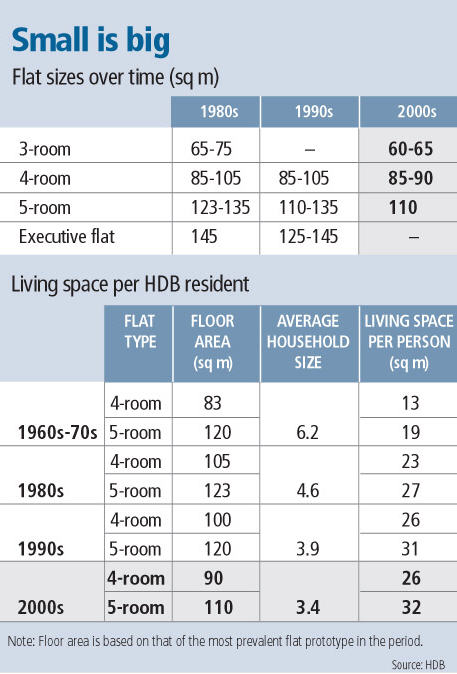
(SINGAPORE) HDB flats have gotten smaller over the years, but most occupants today should actually have more space to themselves as the size of families has also shrunk.
Data that BT obtained from HDB reflects this trend. From the 1980s to 2000s, all types of flats have been scaled down. The changes appear most noticeable between the 1990s and the 2000s.
For instance, a five-room flat built in the last 10 years would measure around 110 square metres, but an older one from the 1990s would be 110-135 sq m, while another hailing from the 1980s would measure some 123-135 sq m.
HDB explained that it 'reviews flat sizes regularly, taking into consideration changes in demographic trends and lifestyle habits, as well as the need to optimise limited land available for housing'.
Home hunters have noticed the change in flat sizes. The difference stands out particularly to those who have been shopping for resale flats across estates, said Dennis Wee Group director Chris Koh.
PropNex chief executive Mohamed Ismail agreed that flats have become smaller in the last 20 to 30 years, but pointed out that there has also been a more 'efficient use of space'.
For instance, most new flats no longer come with large balconies and long corridors. In addition, glass panels have become an increasingly common feature because they create a sense of spaciousness, he said.
While HDB's data confirms that flats have become more compact, it also highlights something less obvious to the casual observer - many residents today should have more living space because their families are smaller.
According to official surveys, the average household size was 3.4 in the 2000s and 4.6 in the 1980s. This means that an occupant in a relatively new 110 sq m five-room flat is likely to have 32 sq m of space to himself, while someone living in a 123 sq m five-roomer in the 1980s probably had just 27 sq m of space.
'Over the years, while flat sizes have been adjusted, living space per person has improved for HDB residents as household size has decreased . . . due to the nuclearisation of families and formation of smaller families,' HDB said.
HDB 'will continue to provide a wide variety of flats and ensure that flat sizes are reviewed regularly to cater to prevailing and future needs'.
Property agents note that flat sizes alone do not influence homebuyers' decisions - other factors such as location and amenities come into play.
As Mr Ismail shared, many people are looking forward to waterfront living in Punggol, even though flats in the area are likely to be smaller than those in older estates such as Yishun. 'The environments cater to different needs. There are pros and cons,' he said.
Still, industry watchers are not keen - and do not expect - to see flats getting smaller as they have to accommodate families.
'There's very little that you can cut back on, unless you want to cut back on the yard area . . . As it is, the room sizes are just nice,' Mr Koh said.
In the private housing sector, condominium units have also shrunk in size. The trend picked up pace from early 2009 when projects with a large proportion of shoebox units measuring less than 500 sq ft started to emerge. Developers have an incentive to keep units small so that they remain affordable even if prices in per square foot terms are high.
BT reported recently that the authorities have been projecting housing supply in the Government Land Sales programme by using smaller estimates for the average size of non-landed homes.
Market watchers do not believe that HDB flats will go the way of shoebox apartments. These private projects 'cater to investors who want to own a second property or to a single who wants to buy . . . but public housing is for a family nucleus', Mr Ismail said.
Source: www.businesstimes.com.sg
Chinese buyers home in on Singapore
by Chris Howells
05:55 AM Dec 29, 2010
SINGAPORE - It has been a good year for agents selling luxury properties to foreigners in Singapore. Ms Jasmine Png, an associate director with real estate agency OrangeTee, says she has never before seen as many earnest buyers from China.
What's drawing them here are "the tightening measures in China and Hong Kong, which have actually made the Singapore residential market look appealing," said Ms Png. The "relative ease in obtaining financing for purchasing Singapore properties" is also helping, she added.
Credit is getting costlier in China. The central bank raised the benchmark interest rate by 25 basis points to 5.81 per cent last Saturday, the second increase since October. Analysts expect another 100-basis-point increase in the first half of next year. They say that the People's Bank of China (PBOC) is still behind the curve in combating inflation and will likely employ a slew of measures next year to contain rising consumer prices and cool the overheated property market.
The authorities in Beijing have already banned mortgages for third-home purchases and restricted developers from pre-sales of properties. These steps, along with the threat of a property tax, have driven some buyers to overseas markets.
According to Singapore's Urban Redevelopment Authority, Chinese nationals have snapped up 1,474 private properties so far this year, surpassing the 1,448 purchases made by Indonesian buyers.
Chinese nationals have accounted for 5.3 per cent of the local private housing market this year. Among foreigners, they are second only to Malaysians, who make up 6 per cent.
In the third quarter, Chinese buyers accounted for 20 per cent of all foreign purchases in Singapore's housing market, the highest ever, according to property consultancy DTZ. Although Singapore, too, has taken steps to damp speculative fervour in the property market, the low borrowing costs here are attracting foreigners, especially the Chinese, who are expecting a significant increase in their home-country interest rates next year.
In the PBOC's previous tightening cycle from March 2006 to August 2008, the central bank raised the lending rate by 189 basis points to 7.47 per cent and increased the reserve requirement ratio for banks by 1,000 basis points, to 17.5 per cent.
After Saturday's increase, the lending rate is currently at 5.81 per cent, though at 18.5 per cent, reserve requirement ratios are already above pre-crisis highs.
Source: www.todayonline.com

